

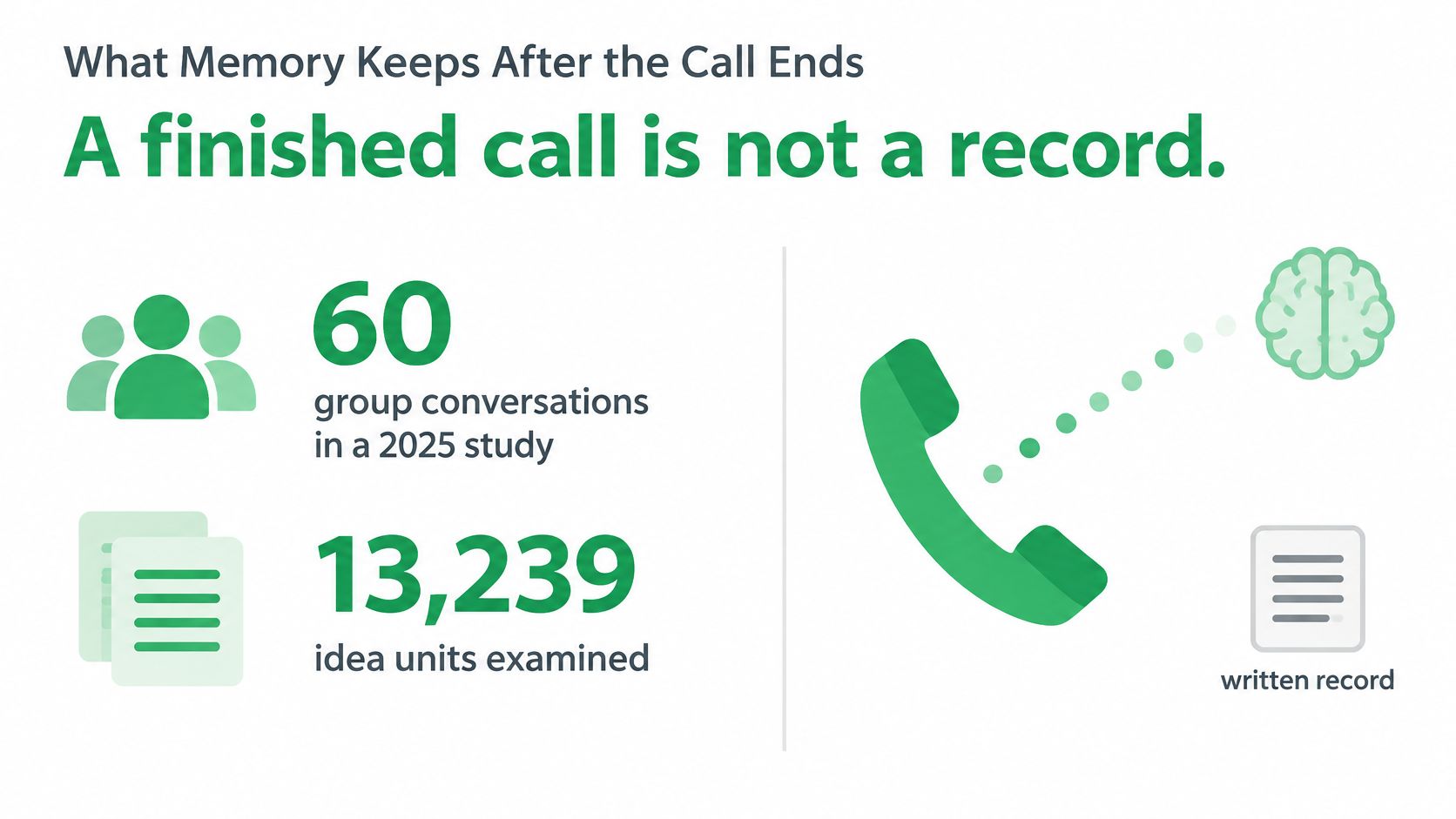
People accurately recalled only 29.83% of what they themselves said in a conversation, which is why transcription is necessary to keep the exact figures, conditions, and commitments a client call produces. The rest of a call decays into an impression, and the impression usually feels reliable.
Those numbers come from a 2025 study of 60 group conversations and 13,239 conversational idea units, published in Memory & Cognition. Participants were often accurate about the fragments they tried to report. They just tried to report very little.
That's the whole problem in one sentence. A mortgage call can feel memorable and still lose the rate hold, the down payment source, and the appraisal condition. An insurance review can feel thorough and lose the exclusion the client asked about.
This article walks through why transcription is necessary for client-facing phone work, what a transcript gives you, where it fails, and which calls deserve one.
Table of Contents
- What Memory Keeps After the Call Ends
- The Written Record a Call Otherwise Lacks
- Why Notes Compete With Listening
- Errors to Recheck Before the Client File
- When a Spoken Decision Needs a File
- Accents and Calls That Need a Second Look
- Choose the Calls Worth Writing Down
What Memory Keeps After the Call Ends
A client call produces two versions of itself: the one that was spoken, and the one you carry away. The carried version feels complete. A 2025 Memory & Cognition study measured how much of a real conversation each participant could accurately report afterward, and the gap between the two versions is larger than it feels.
How much of a conversation people accurately recall
| What was said | Accurately recalled | What this means on a client call |
|---|---|---|
| Your own words | 29.83% | Most of what you explained is never reported later |
| Words said directly to you | 22.86% | Figures, dates, and requests aimed at you are easy to lose |
| Remarks you only overheard | 12.05% | Side comments and context rarely survive |
| Strongest individual recall | 44.12% of what was said | Even the best memory kept under half the call |
| Weakest individual recall | 7.37% of what was said | Nearly the whole conversation was omitted |
Read the top row as a mortgage broker. In four minutes you explain a rate hold, a down payment source, a document the lender will request, and what happens if the appraisal comes in low. Later, none of those sentences are available. What's left is "the client seemed ready." The rate hold number is gone, and the exception attached to it went with it.
The second row catches advisors who are certain they were paying attention. A client says the group life coverage through work ends in March, that the renewal quote should exclude the dental rider, that the transfer has to clear before the tax year closes. Words aimed directly at you survive at 22.86%. She said it once, clearly, to you.
Remarks you only overheard land at 12.05%. That's the spouse in the background mentioning they can't close before the 15th, or the assistant naming the previous insurer. Side comments carry context, and context is what disappears first.
What memory keeps is biased toward feeling. It holds the client's frustration with her last lender and the relief at hearing the premium. It drops what carried no emotion, which is exactly the digits, the effective date, and the clause.
A call can feel reliable because the fragments you do recall are correct. The trouble is the size of the sample.
The spread between the strongest and weakest participants is the part that should unsettle you. One person captured 44.12% of what was said, another 7.37%, and neither could tell you in advance which one they'd be on a given Tuesday.
A transcript is a different object entirely: a durable, searchable account you check later instead of reconstructing from partial recollection. Brokers, insurance advisors, planners, and field salespeople make follow-up decisions on verbal details, and verbal detail is the first thing recall discards.
If you want a benchmark for how much detail a well-built record retains, Ansa publishes exactly what caller information stored after each call includes, which is a far better comparison point than a vendor's promise of "full context."
Recall selects by emotion and convenience. A written record keeps what you chose to write down.
The Written Record a Call Otherwise Lacks
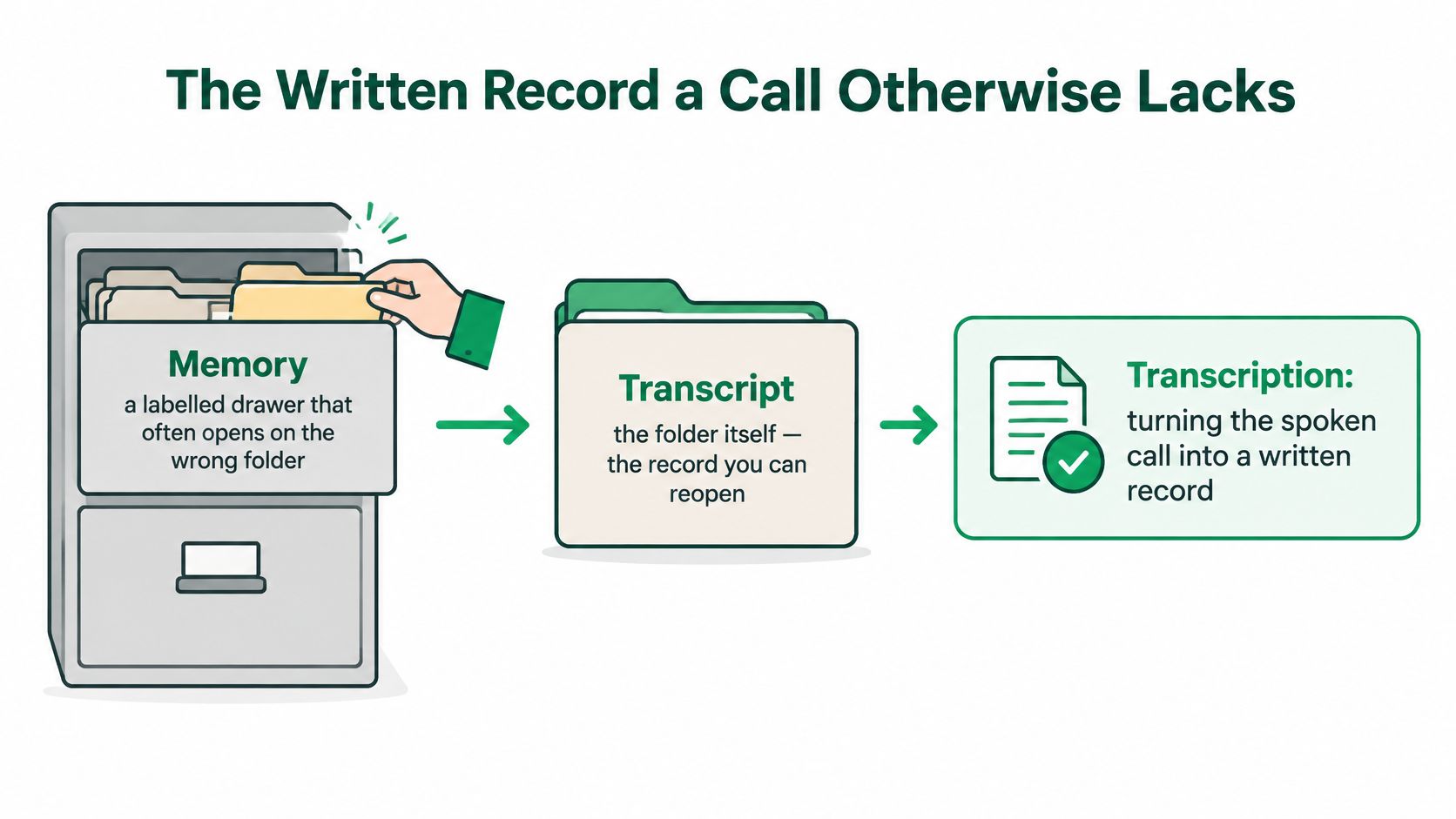
Think of memory as a filing cabinet where every drawer has a confident label. You reach for "renewal call, March" and pull a folder from a different year. The label felt right. The folder wasn't.
Transcription is the act of turning the spoken call into text you can reread, search, and set beside the later email or the client file. It isn't a smarter cabinet. It's the folder itself, sitting exactly where you left it.
Four things that belong in the filing cabinet
- The figures you quoted. The premium, the rate, the loan amount, the limit. Not a rounded version you'd feel comfortable repeating.
- The conditions attached to them. "If the appraisal comes in under the purchase price" changes everything downstream and is spoken once, in passing.
- The decisions. What the client agreed to, and what he explicitly deferred.
- The next step and its owner. Who sends what, to whom, by when, including the items you owe.
Take one renewal call. An advisor discusses raising a life policy limit, walks through the cost difference, and agrees to send an illustration. Two weeks later she remembers the conversation went well and that coverage would change. She doesn't remember the limit discussed, the effective date the client wanted, or which document he promised to return. All three were said out loud. None of them survived as words.
That gap has a cost at the team level. In 2024, 40% of surveyed workers in the United States and United Kingdom said they did not receive follow-up notes or action items after meetings, a figure Calendly published from Brand Over Matter research among 1,244 workers. On the renewal call, the missing note is the limit, the date, and the document.
A summary is a map of the folder, useful for a fast reread. The transcript is the source when a sentence matters. Keep them in that order and you won't confuse a tidy paragraph with a checked fact.
Separate facts from impressions while you're in there. "The client asked for a 20-year term" is checkable against the text. "The client sounded hesitant" is your reading of tone and belongs in a note labelled as interpretation. Making logging phone calls a habit keeps both, in the right place, without extra typing.
A test worth running this week: after your next important call, pull one decision, one number, and one next step from the written record, then ask what memory held on its own.
Why Notes Compete With Listening
You can watch the road or read a map in your lap. Doing both at a junction is how turns get missed. A client call has junctions too, and they usually arrive as a qualifier.
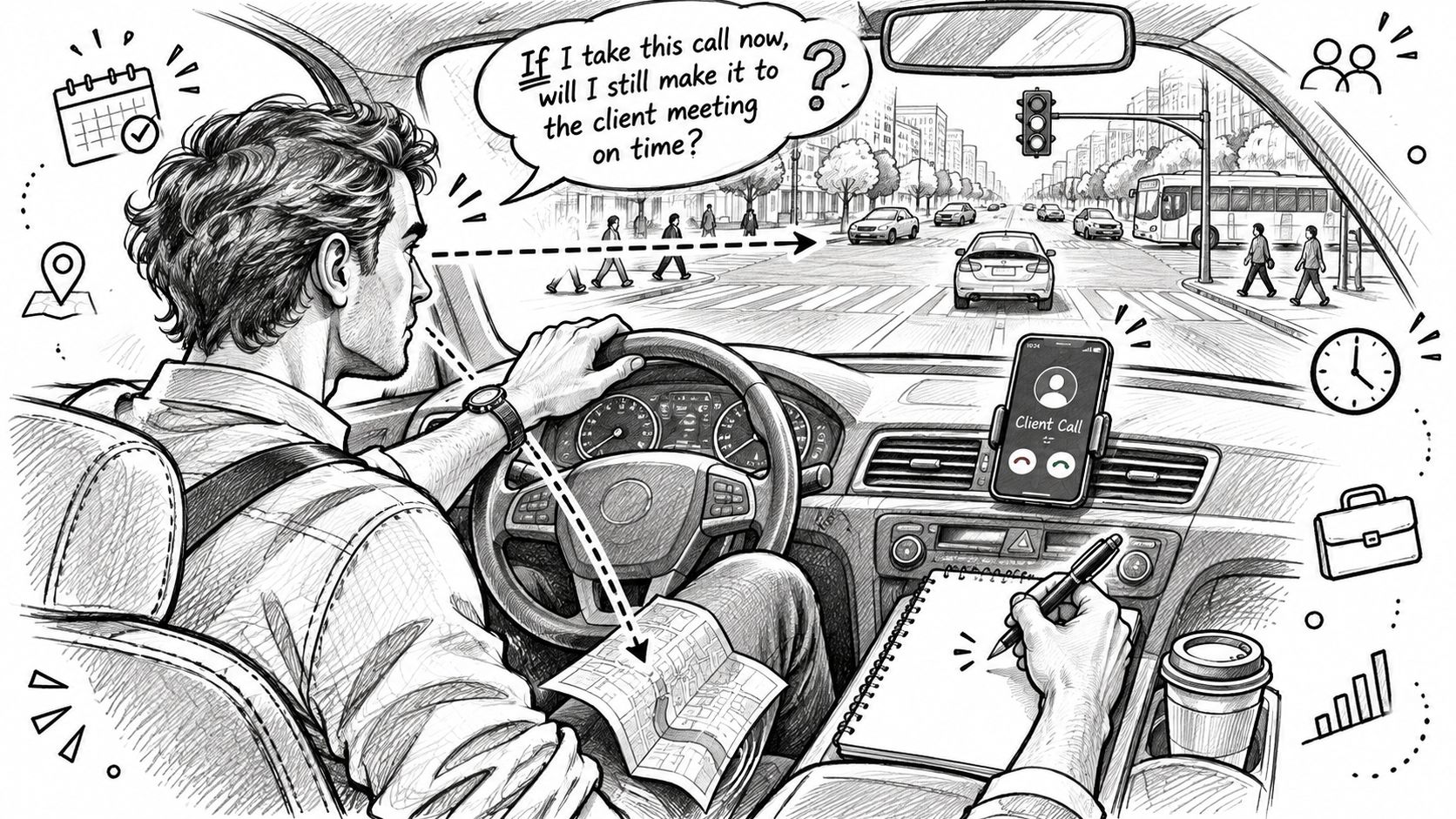
The cost of splitting attention is measurable. Controlled work on speech-recognition tasks found that transcription errors, limited editing, processing delays, and the need to monitor generated text all raised cognitive load and lowered perceived usability, especially on complex tasks, as reported in this review of speech-recognition workload research. Handwriting your own notes carries the same tax in a different currency.
Here's the junction in practice. A borrower says his income is $92,000, then adds that only $58,000 of it counts because the rest is a one-time bonus the lender won't consider. Write the first number and look up, and you've recorded the wrong one with total confidence. The qualifier came after the pause, which is exactly when you were finishing the sentence in your head.
The same pattern shows up with a renewal date, a requested document, an underwriting exception, or a promise to send something by Friday. Key information in professional calls is conditional and scattered. It rarely arrives in the tidy order your notes assume, and you can't write fast enough to fix that.
Listen first and verify after
- Stay in the conversation. Let a contemporaneous transcript hold the full exchange while you interpret, question, and respond.
- Treat the text as the source record. Names, dollar amounts, dates, coverage limits, addresses, and commitments get checked against it before anything enters a CRM or client file.
- Read the summary for orientation, not proof. Summaries speed up the later pass. They don't replace a line-level look at the field that matters.
- Log the checked version, not the draft. The first read is raw material.
Recall tools can raise confidence without being right. Memory that fills in a plausible number feels exactly like memory that kept the accurate one, so a confident recollection still earns a check against the text before it enters a file.
Place a time cost beside the attention cost. In 2023, the median time spent documenting quality-indicator data was 60 minutes per working day, with a middle range of 30 to 90 minutes, from an original study in BMJ Open. In a broker's or advisor's day, that hour is the stack of figures and owners that live note-taking tries to catch mid-sentence.
Move it after hang-up instead. If you're rebuilding your note habit around this, these focused note-taking techniques work well on a transcript and badly on a live call.
Neat handwriting isn't proof you heard the condition. It's proof you were writing while someone spoke.
Errors to Recheck Before the Client File
A transcript earns its place because it can be inspected, not because the first draft is right. That distinction decides whether it makes your file stronger or poisons it.
The clearest error data comes from clinical documentation, and the transfer warning matters more than the setting.
How review changes speech-draft errors
| Stage | Error level | What to copy into a call workflow |
|---|---|---|
| Speech-recognition draft | 7.4% of words or units | Treat the first text as unchecked |
| After professional review | 0.4% of words or units | A second reader removes most errors |
| After physician review and signature | 0.3% of words or units | The accountable person still checks material facts |
| Dictation-file analysis | About 315,000 errors per 1 million dictations | Volume alone does not make voice-to-text safe |
Those figures come from a 2018 study of 217 clinical notes across two healthcare organizations, detailed in this analysis of speech recognition in clinical documentation. The same work reports a separate look at 2,391 physician dictation files and roughly 315,000 errors per 1 million dictations.
These are medical records, not mortgage or insurance calls. Copy the habit, not the setting. An unreviewed voice-to-text draft can put a wrong digit into a durable file, and a wrong digit in a durable file outlives a vague memory every time.
The fields to check first
Work down this list in order before anything reaches a client record:
- Person and product names. "Term 20" and "Term 10" are one character apart and decades apart in meaning.
- Dollar amounts and percentages. Premium, coverage, loan amount, rate, down payment.
- Dates. Effective date, renewal date, closing date, expiry of a rate hold.
- Addresses and property details. A blurred street number is a real risk on a car call.
- Limits and conditions. Coverage caps, exclusions, lender exceptions.
- Promised actions. Who sends what, to whom, by when.
A single slipped character is the whole danger. Say a premium of $184 a month comes through the draft as $148. Nothing in the sentence looks wrong. It reads cleanly, it sits in the CRM, and three follow-up emails later the client is asking why the quoted figure changed.
The order that holds up is summary first for orientation, transcript second for any high-risk field, correction third, entry last. Read the draft, fix the figure, then let the checked version into the file.
Don't send an automated follow-up that repeats a number nobody verified. The automation makes the error sound official.
When a Spoken Decision Needs a File
Personal memory is a convenience. Accountability is a requirement, and requirements don't care how confident you felt on the call.
U.S. investment-adviser rules generally require records of advisory business and client communications to be kept for at least five years, with the most recent two years readily accessible to regulators. Canadian investment firms carry similar obligations to retain and retrieve business communications for supervision and audits, as Practifi's compliance overview sets out. Both regimes assume a searchable record exists.
Searchable means more than stored. A structured transcript lets someone pull every call with one client, or every conversation where a specific term was used, without replaying hours of audio or trusting a handwritten page.
What a defensible file contains
- Who took part, including anyone who joined late or was mentioned as a third party.
- When it happened, with the metadata intact.
- Restricted access, limited by role rather than shared by default.
- A retention and deletion rule, written down and followed.
- A clear split between facts checked by a human and the summary that describes them.
The operational payoffs are concrete. A manager samples calls for disclosure language, suitability discussion, and consent. An advisor spots a missing document before an application moves. A follow-up draft is checked line by line against what was said.
Then the boundary. A transcript is evidence of what the system heard. It isn't proof, and it isn't advice. You're responsible for the transcription rules that apply to you and your profession, and those vary from place to place. Before recording, you're responsible for informing every participant and obtaining any consent the law requires, including telling someone who doesn't use the app that the call may be recorded and stored. A verbal disclosure to a business client can cover the current call and future calls of the same kind where that method is allowed. Transcriptions and summaries aren't legal, medical, or financial advice, and they aren't certified documents or evidence in legal proceedings.
Get the plumbing right and the compliance gets easier. Teams that wire transcripts into their CRM integration services stop copying figures by hand, which removes one more place for a digit to drift.
The challenge test: if this decision might be questioned in five years, does a memory note still look like a sensible answer?
Accents and Calls That Need a Second Look
Transcription isn't equally reliable for every caller, and pretending otherwise is how a precise-looking error gets into a file.
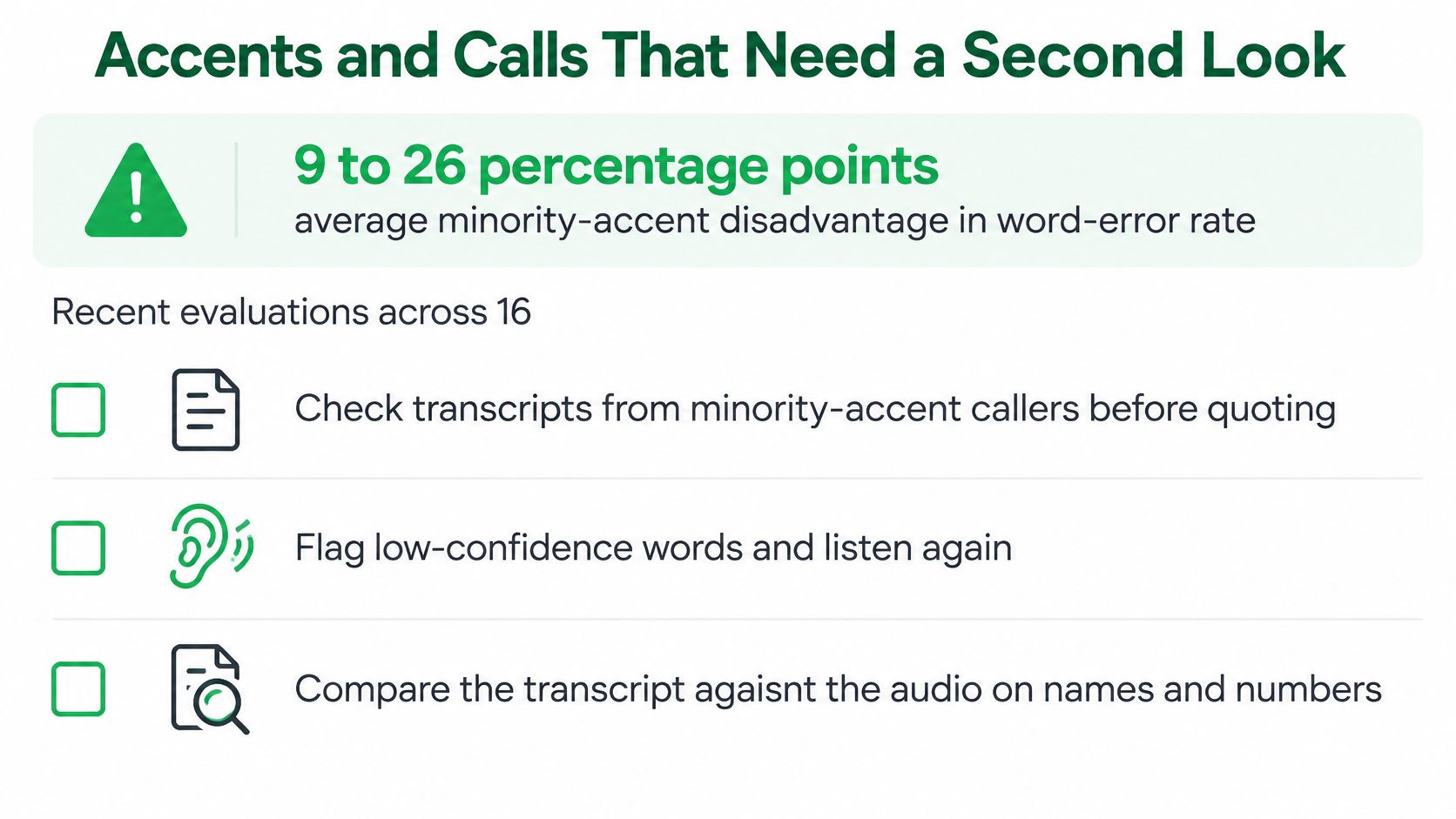
Speech recognition handles clean, standard English best. Accented speech, regional dialects, second-language English, and noisy phone lines all push error rates up, sometimes sharply, and the mistakes tend to land exactly where a call matters: names, numbers, product terms.
That matters because a written error is more dangerous than a missing note. A blank space makes you call the client back. A wrong number in a clean sentence makes you quote it.
Two short cases show the pattern. A bilingual insurance client switches between languages mid-sentence, and the coverage name comes back as something that exists but isn't what she has. An advisor in a noisy car blurs a street address by one digit, and the courier goes to the wrong building.
What to do with a passage you don't trust
- Keep the transcript as a working record that still gets checked before anything is filed.
- Recheck figures and commitments against what the client said before they leave your desk.
- Flag anything odd. A product name you don't recognize, a number that jumps, a sentence that doesn't parse.
- Hold the automated follow-up when a critical detail may have been misheard.
Phone audio, regional accents, and second-language English are everyday conditions in Canadian and U.S. client work. Expect them on a share of calls, and plan your review time around them.
This short walkthrough shows how much a recording can hide from a machine.
None of this argues against transcription. It argues against blind trust. A transcript remains necessary for audit and recall, and responsibility for the checked facts stays with the person who gave the advice.
Choose the Calls Worth Writing Down
The keep-or-skip rule is simple. Transcribe when someone later may need the figure, the condition, the decision, or the next step. Skip when nothing material was said and you're sure of it.
Calls that usually qualify are the mortgage fact-find, the insurance needs conversation or quote, the investment instruction, the technical specification, and any call where a document or deadline is promised. A two-minute rescheduling exchange usually doesn't, once you've confirmed nothing changed.
Then apply the checks already in play rather than inventing new ones. Consent handled before recording. Names and numbers read by a human. Extra care on a weak or accented recording. No treating any of it as certified advice or legal proof.
For a reader handling these calls on a mobile number in Canada or the United States, VoxNote transcribes every incoming and outgoing call on your existing number once call forwarding is connected, with the transcript and summary arriving seconds after you hang up, and you can exclude a contact ahead of time or stop transcription mid-call. The review, the edits, and the decision about what enters the client file stay with you.
Tomorrow, pick the next call that will produce a number or a promise. Disclose recording if the law where you work requires it. Then file only what a person has checked.
Your next client call will produce a figure, a condition, and a promise, and the odds of holding all three in your head are worse than you think. VoxNote turns incoming and outgoing calls on your existing number into a transcript and a summary that land seconds after you hang up, so the review starts from a written record instead of a guess. Visit VoxNote to see how the transcript reaches your client file, and bring your own checklist to the first call.