
You've just finished a client call, and your notes say “send documents Friday.” But which documents? Did the client agree to send them, or did you promise to? And was the amount you discussed fifteen thousand or fifty thousand?
Phone call transcription gives you a written starting point instead of asking you to reconstruct the conversation from memory. The useful habit is to treat that text as a draft record, then verify the details that could affect a client's money, decisions, or deadlines. Consent, access, and deletion belong in that workflow from the beginning.
Table of Contents
How Phone Call Transcription Works
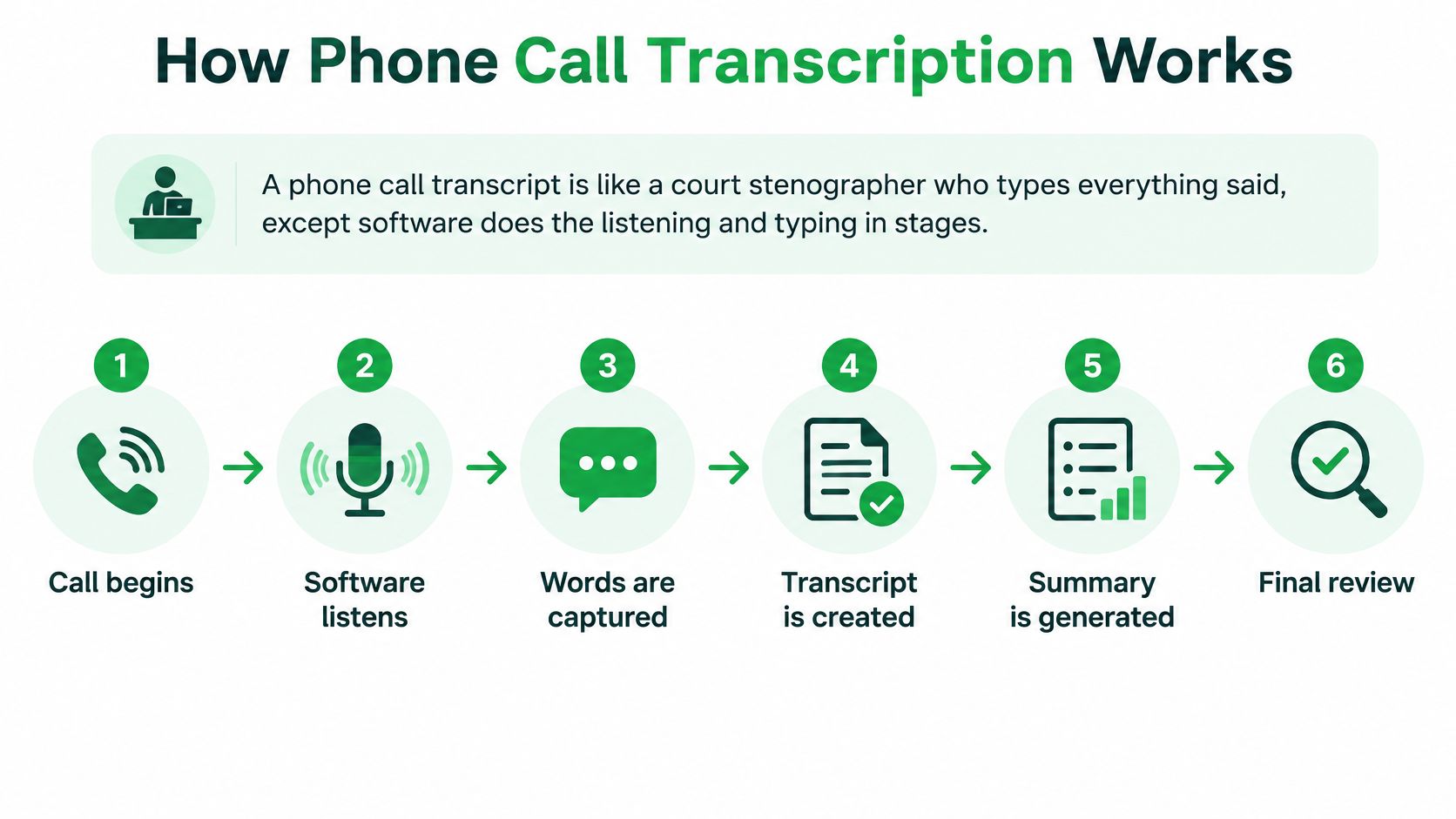
A phone call transcript is like a court stenographer's record, except software does the listening and typing in stages. The comparison has a limit: software can produce readable sentences that don't accurately reflect what someone said.
From the call to a written draft
Capture the conversation. In a call-forwarding setup, incoming calls reach the transcription service, while outgoing calls go through its app. Recording-enabled call flows capture audio from the moment the call begins, so consent arrangements need attention before sensitive discussion starts.
Separate the voices. The system distinguishes the professional's speech from the client's. Separate audio channels, where supported, provide a stronger basis for attribution than a single mixed recording; NIST's telephone-speech evaluation plan describes channel-based evaluation arrangements.
Turn speech into text. A speech-recognition model matches sound patterns to words, while language modeling helps select likely word sequences. It isn't just looking up each sound in a dictionary, because surrounding words influence the result.
Identify the language. Automatic language detection helps the system process multilingual conversations. Switching languages mid-sentence can still cause mistakes, so inspect those passages rather than assuming detection guarantees accurate transcription.
Add punctuation and generate a summary. Software organizes the text and extracts points such as figures, decisions, and next steps. A summary is a separate interpretation of the transcript, not a replacement for it.
Save the record and prepare the next action. The transcript is stored, and a follow-up draft may be generated. Audio deletion follows the service's retention policy, which can differ from the policy for written records.
The flow below shows how capture leads to review.
Find the stage that needs checking
For a concrete example of speaker labeling in another professional setting, PatientNotes' guidance on speaker-separated patient transcripts is a useful reference. Correct words under the wrong speaker's name still make an unreliable record.
Telephone audio also has limited bandwidth and often includes noise and spontaneous speech, challenges described in Columbia University's speech-recognition lecture materials. Missing speech suggests a capture problem; wrong words suggest recognition trouble; an incorrect action owner suggests attribution or summarization needs checking.
How Accurate Phone Call Transcripts Are and Where Errors Hide
Word error rate, usually shortened to WER, measures substitutions, deletions, and insertions against the word count in a human reference transcript. It's more informative than an unexplained accuracy percentage because it tells you what was compared.
The historical benchmark matters, but so does its scope. In a 2016 study, Microsoft researchers reported approximately 5.9% WER on Switchboard, compared with 5.8% for human transcription, while the harder CallHome benchmark produced 11.3% for the system and 11.0% for humans, as described in the NIST-hosted telephone-speech paper.
Those results concern particular English telephone-conversation benchmarks. They aren't a promise about a client speaking through a car microphone, an unfamiliar surname, or a discussion full of mortgage terminology.
The errors that change the meaning
A transcript can look polished while containing a consequential mistake. These examples show why review should focus on meaning, not just spelling.
Transcription error types and their impact on calls
| Error type | Example on a call | Why it matters |
|---|---|---|
| Deletion | We do not cover that becomes We cover that | Drops a condition, commitment, or figure |
| Substitution | Fifteen thousand becomes fifty thousand | Changes an amount, rate, date, or name |
| Insertion | A word the client never said appears in the notes | Creates a statement that was never made |
| Speaker mix-up | The client's words are attributed to the advisor | Misstates who agreed to what |
Speaker mix-up isn't counted in ordinary WER. Score attribution separately, because a transcript can contain all the correct words while assigning a promise to the wrong person.
Conditions that deserve closer inspection include:
- Noisy vehicles and speakerphones. Road noise, echo, and distant microphones can obscure speech.
- Interruptions and overlapping voices. Check whether a short answer belongs to the question immediately before it.
- Regional accents and multilingual passages. Test the languages and accents your clients use.
- Names and specialized vocabulary. Product names, loan terms, and unfamiliar addresses need deliberate review.
An evaluation of speech-recognition models across accents and languages highlights uneven performance and the limitations of systems optimized for standard English. Don't treat an English-language demonstration as validation for every client group.
Measure your own calls
Build a small, permissioned test set representing your working conditions. Have a careful reviewer produce a reference transcript, then compare the machine output against it.
Add substitutions, deletions, and insertions, and divide that total by the reference word count. Keep separate results for clean mobile audio, overlapping speech, noisy environments, and the languages you use rather than hiding difficult calls inside an average.
Also maintain a critical-detail error log. An incorrect interest rate deserves attention even when the surrounding paragraph is flawless.
Practical rule: Verify every rate, amount, date, name, and commitment against available audio before relying on it. If audio isn't available, confirm consequential details with the client or an authoritative document.
Consent and Disclosure Rules for Recorded Calls
The applicable rules can depend on where participants are located and which professional obligations apply. You're responsible for following the call transcription rules that apply to you and your profession, including when a client answers from another jurisdiction.
Canadian organizations recording customer calls must identify the purpose, notify the customer, obtain consent, and retain recordings only as long as necessary, whether the customer or organization initiated the call, according to the Office of the Privacy Commissioner of Canada's call-recording guidance.
Consent rules by jurisdiction for recorded calls
| Jurisdiction | Consent rule | What it means for your calls |
|---|---|---|
| Canada, federal privacy guidance | Identify the purpose, notify the caller, obtain consent, and keep recordings only as long as needed | Disclose at the start, including calls you initiate |
| United States, federal law | Generally one-party consent | Don't treat permission to capture as a complete privacy policy |
| United States, several states | All-party consent required | Establish which rules apply and obtain every participant's agreement where required |
This is a starting framework, not a jurisdiction-specific legal opinion. For cross-border calls, have qualified counsel approve your workflow rather than assuming your office's location settles the question.
Make disclosure part of the call
Our recommendation is verbal disclosure at the start of each call: explain that it's recorded and transcribed, state the purpose, and ask whether the other person wishes to proceed. Adapt this example to your actual use:
This call is being recorded and transcribed so I have an accurate record. The purpose is to review your mortgage options. Do you agree to continue?
If summaries or follow-up drafts are part of that use, explain them in your privacy information. Don't describe the process as temporary audio handling while leaving clients unaware that written records remain.
Our phone call recording guide provides additional operational context. For businesses that also handle bookings, Dial Milo's legal guidance for appointment-based callers offers a related workflow perspective, not a substitute for advice about your profession.
Handle refusal without pressure
- Pause the substantive discussion. If the client declines, stop recording and transcription before continuing.
- Document the outcome. Note the consent or refusal in the client file without continuing an unwanted recording merely to preserve that note.
- Use a fallback. Take permitted manual notes or arrange another communication method.
- Recheck when someone joins. Explain the recording arrangement to the new participant and obtain the agreement required before proceeding.
Automatic capture creates a practical issue: a spoken disclosure after connection doesn't undo audio already captured. Where prior permission is necessary, arrange it before using a recording-enabled call flow.
One-party consent isn't a complete business policy. Purpose, access, retention, and vendor handling still need decisions.
Set Up Transcription on Your Own Phone Number
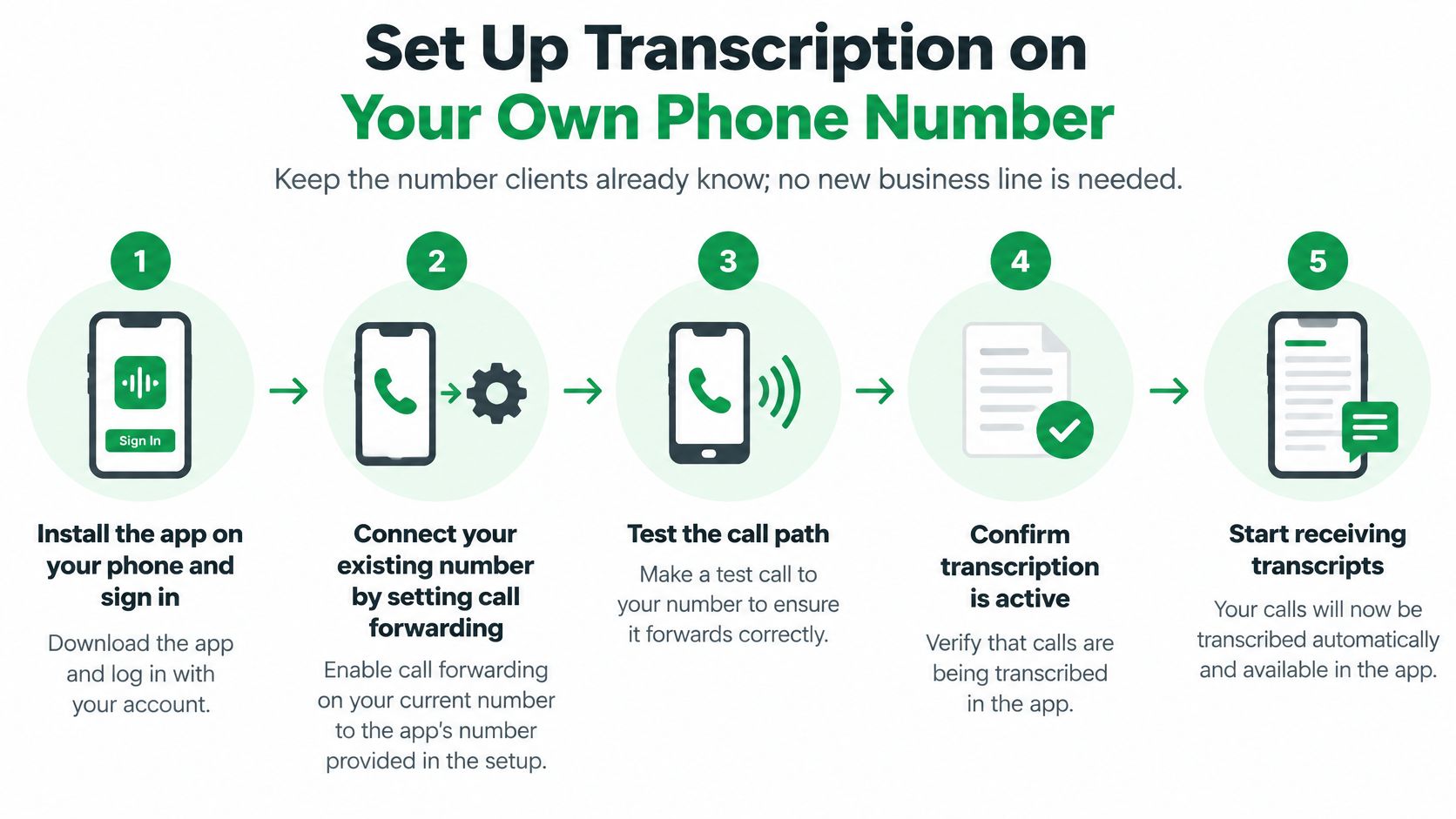
You can retain the number clients already know rather than introduce a separate business line. The setup below describes our existing-number workflow, with testing before any live client discussion.
The diagram gives you the basic connection sequence.
Connect and test the call path
Install the app and sign in. Use the iPhone you normally use for professional calls. Complete the initial account setup before changing how incoming calls are routed.
Connect your existing number through call forwarding. Follow the instructions for your carrier and review our call-forwarding options. Once forwarding is configured, incoming calls are captured automatically, with nothing to press during the conversation.
Run a test from another phone. Ask a colleague who agrees to the test to call your usual number, exchange a few harmless details, and hang up. Open the Notes tab and confirm that a transcript and summary appear, including speech from both participants.
Exclude contacts that shouldn't be transcribed. Set this up before their next call. A family member or a client who has declined recording shouldn't depend on you remembering to stop capture after answering.
Place outgoing calls from inside the app. This routes them through the transcription flow while the client still sees your own number. Test this direction too, because successfully receiving a forwarded call doesn't prove that you've used the correct outgoing route.
Practice stopping transcription mid-call. Use an internal test to locate the control and confirm that transcription has stopped before continuing. Don't learn the refusal procedure while a client is waiting.
Check completeness, not just delivery
A delivered summary proves that processing occurred, but it doesn't establish that the whole conversation was captured correctly. During your test, have each participant state a name, a next step, and a harmless reference detail, then inspect the result.
Check the opening and closing exchanges as well as the middle. If a voice is absent or the record ends early, resolve that before using the workflow for client instructions.
A working connection and a compliant conversation are separate checks. You need both before moving from a test call to client work.
Keep the disclosure wording ready to read aloud, and arrange advance consent where the applicable rules require it. The convenience of automatic capture shouldn't determine when you ask permission.
How Long Transcripts Are Kept and Who Can Read Them
Audio and written records are different data categories. Deleting a recording doesn't delete its transcript, summary, or generated tasks, so your retention policy needs to address each category.
Our ordinary call audio is deleted after the transcription is saved, normally shortly after processing. Deletion from temporary telephony and transcription systems can be delayed by retries, outages, security incidents, or legal obligations.
Retention and access are separate decisions
We keep call metadata, transcripts, summaries, and related generated tasks for up to 36 months from the call, unless deleted earlier or a longer period is required by law. That's a service retention period, not an instruction to retain every client conversation for that long.
The professional and authorized team members can work with call records through the app or web application. Access from a computer is useful for updating client files, but it also means you should think beyond the security of the phone itself.
We don't have employees routinely listen to recordings or read call content as part of transcription. That statement describes routine processing; it shouldn't be expanded into a claim that no exceptional access could ever occur.
Apply these tests to your firm
- How long is each record needed? Distinguish an unfinished application, a completed transaction, and a disputed instruction. Set schedules that reflect your professional and legal obligations.
- Who needs access? Grant access based on the work someone performs, not because they belong to the brokerage. Review access when responsibilities change or colleagues leave.
- Can a deletion request be handled correctly? Identify where copies have gone, including client files and email, and assess any obligation to retain them before responding.
A copied summary is another record to manage. Deleting the original transcript won't automatically remove text someone pasted into a separate client system.
A maximum isn't a target. A shorter documented schedule may be appropriate when it meets your firm's needs and applicable duties; a legal preservation requirement may instead require longer retention. Record the reason for your choice and assign someone to carry it out.
Turn Transcripts Into Accurate Client Follow-Ups
Treat the transcript as material to check, not a message ready to send. A fluent follow-up can still repeat a recognition error or turn a tentative discussion into a firm commitment.
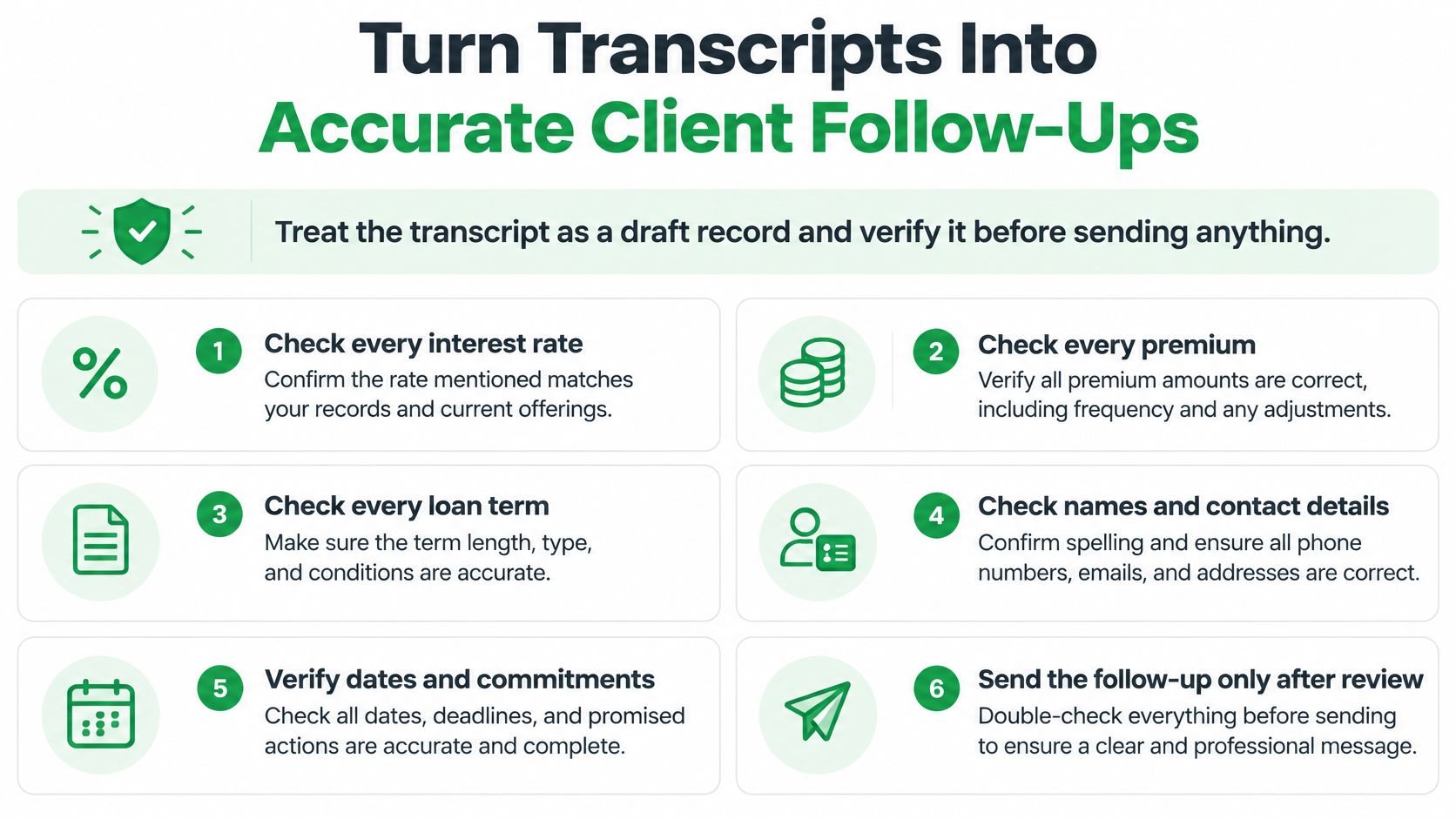
Use this checklist before sending client-facing text.
Review the details that drive action
- Check financial terms against available audio. Verify interest rates, premiums, loan amounts, and fees, because a plausible-looking figure can still be wrong.
- Confirm dates and deadlines. Check the calendar, including the day of the week, and resolve relative phrases such as next Friday.
- Inspect names and references. Verify spellings, addresses, and account references using an appropriate client record rather than guessing.
- Look for negations and conditions. Words such as not, never, and unless can reverse an instruction or limit a promise.
- Assign each next step to its owner. Distinguish what the client agreed to provide from what you agreed to send.
- Compare the summary with the full transcript. Restore conditions or uncertainty that disappeared during compression.
These checks address different failure points. Speech recognition can mishear a figure, speaker labeling can misassign responsibility, and summarization can omit the qualification that made a statement accurate; published telephone-speech comparisons illustrate why performance changes with conversational and recording conditions.
Correct the record before drafting around it
When you find an error, correct the record and note the amendment date and reason. If the error affected advice, a decision, or an earlier message, tell the client and clarify what changes.
Where original audio is available and lawful to retain, preserve relevant material during a dispute under your approved retention process. Don't assume you can replay our calls later, because ordinary audio is deleted after processing; if it's unavailable, seek confirmation and document the uncertainty.
A disputed sentence is a reason to investigate, not a reason to choose whichever version is more convenient.
Build the email around confirmed facts, open questions, and the next dated action. For example, confirm the documents discussed, identify an unresolved spelling or deadline, then state who will do what once that question is answered.
Our guide to sending a professional follow-up email can help organize that message. Keep tentative terms visibly tentative, and send only after your review.
Run Your First Week of Verified Transcription
Use the first week to test a controlled workflow rather than accumulate an unchecked archive. This rollout keeps a clear decision attached to each day.
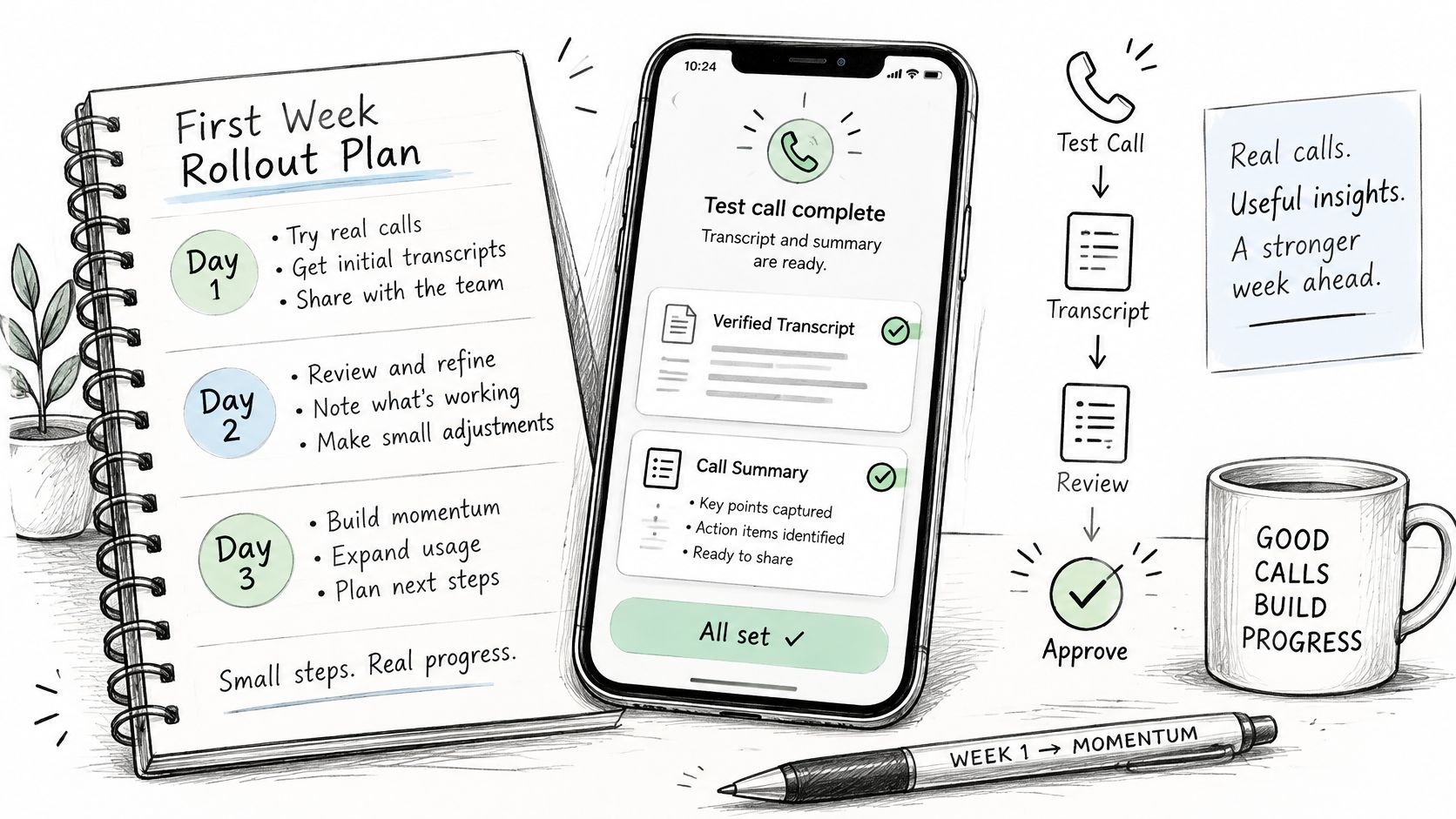
- Day 1: Complete an internal test and confirm that the transcript and summary arrive.
- Days 2 and 3: Review permissioned calls using the verification checklist. Log deletions, substitutions, insertions, and speaker mix-ups, using available audio or direct confirmation.
- Day 4: Adjust disclosure wording if clients found it unclear. Trial the refusal procedure with a colleague who agrees to participate.
- Day 5: Finalize your retention schedule, name its owner, and set a review date.
Our call summary, including a title, appears in the Notes tab seconds after you hang up and is also sent to your inbox. Prompt delivery helps you begin review while the conversation is fresh, but you still check figures and dates before sending anything.
Use the video as a companion to your practical test.
Book one live client call this week, arrange the required consent, and verify its follow-up line by line before sending it.
VoxNote turns calls on your existing phone number into transcripts, summaries, and follow-up drafts that you can review. Visit VoxNote to explore the workflow and start with a consented test call before using it for client follow-ups.