
You're finishing a client meeting when another call comes in. You let it ring, expecting voicemail to handle it, but what you need is an assistant to answer or a written record you can act on later. Turning on forwarding might help, but the wrong rule can divert calls you wanted to answer, leave conversations undocumented, or add charges to your mobile bill.
The useful way to compare call forwarding options is to ask three questions: which calls should move, where should they go, and who pays for the forwarded portion? Start with the routing decision, then configure the phone.
Table of Contents
- Test each condition independently
- Protect the account and the conversation
- Start with a documented decision
Forwarding Modes Compared at a Glance
Unconditional forwarding, often labelled Always, sends every incoming call immediately to another number. Busy forwarding activates when your line is engaged. No-reply forwarding waits until you haven't answered within the network's ring timeout. Unreachable forwarding handles calls when your phone can't be reached, such as when it's switched off or outside coverage.
Those triggers solve different problems. A broker losing overlapping calls needs a different arrangement from an advisor who wants every incoming conversation to pass through a documentation service.
Call forwarding modes on the same criteria
| Option | Activates when | Best for | Main trade-off |
|---|---|---|---|
| Unconditional (always) | Every incoming call, immediately | Calls that must reach a designated destination rather than the original voicemail | Your original line never rings for those calls |
| Busy | Your line is already in a call | Overlapping calls while you're speaking with someone | Calls you answer directly stay on your phone |
| No reply | Phone rings for a set time with no answer | Answering first, with a backup | The carrier sets the timeout; voicemail can compete |
| Unreachable | Phone is off, in airplane mode or out of signal | Backup when the handset can't receive calls | Carrier support and destination availability still matter |
The ITU-T forwarding specification distinguishes unconditional, busy and no-reply forwarding and describes a limit of three to five forwarding connections per call in its ISDN framework. That historical limit isn't a universal rule for today's mobile plans, but it illustrates why sending calls through a chain of destinations is a poor design.
Keep the route short. Forwarding an office line to a mobile, then to an assistant, then back to the office can produce failed calls or confusing voicemail behaviour.
Practical rule: Choose the trigger that addresses the calls you lose today, not the option that sounds most complete.
Unconditional forwarding also doesn't guarantee a human answer. It guarantees a routing attempt to the configured destination, which still needs its own answering arrangement.
How to Turn On Forwarding on iPhone and Android
Set forwarding while your phone has cellular coverage. The handset needs to send the request to the carrier; changing a screen setting without a successful network response isn't enough.
Have the destination number ready before you begin. Copy it directly from the destination service or confirm it with the person receiving your calls, rather than reconstructing it from memory.
The setup paths below show the basic device workflow.
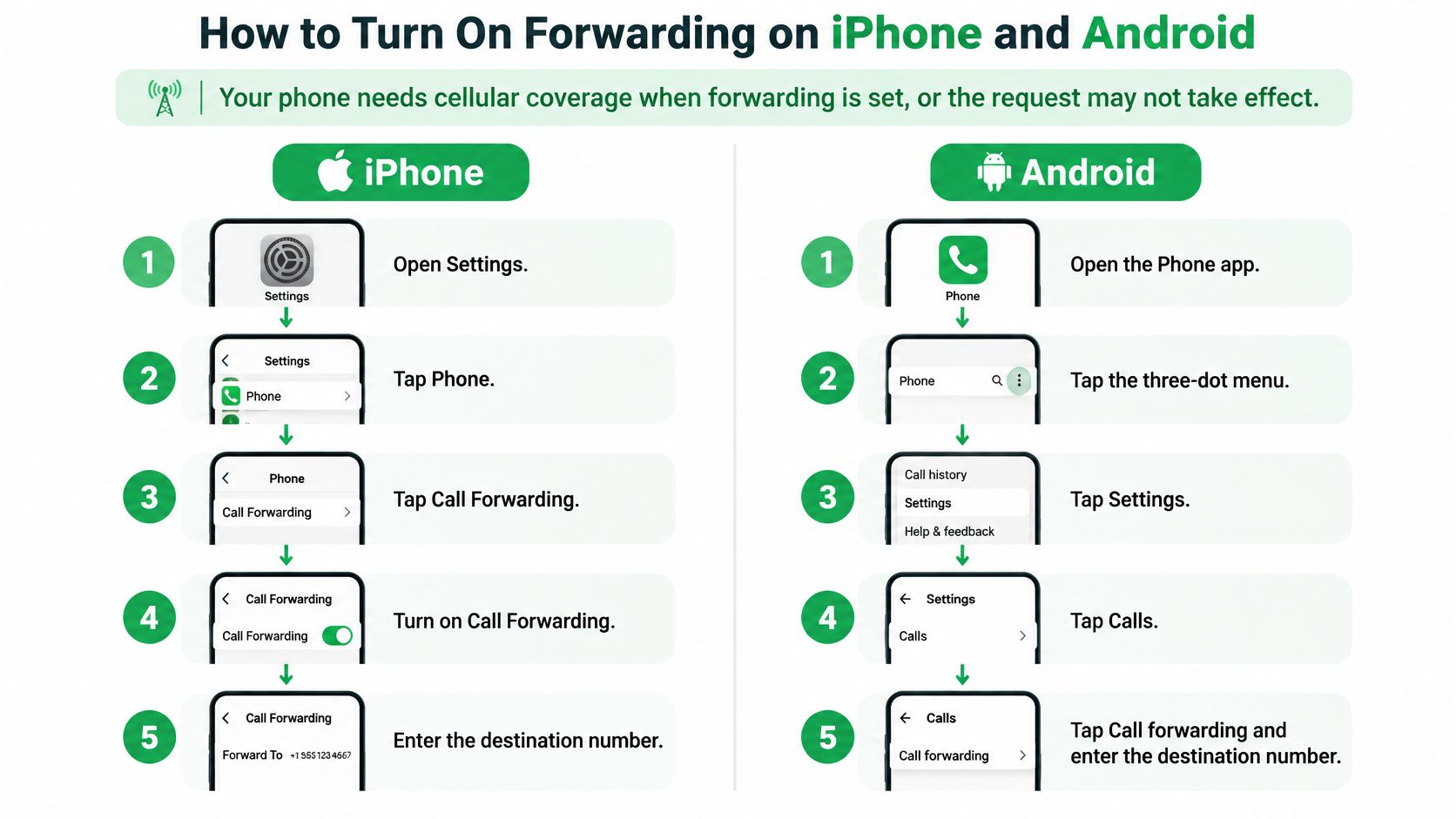
Set the always rule on iPhone
- Open Settings.
- Search for Call forwarding.
- Open Call Forwarding.
- Turn on Call Forwarding.
- Tap Forward To.
- Paste or type the destination number.
- Go back to save.
When connecting our inbound workflow, paste the VoxNote number assigned during setup. Don't substitute your own mobile number, which would send calls toward the line you're trying to redirect.
Set the always rule on Android
- Open the Phone app.
- Tap the three-dot menu.
- Select Settings or Call settings.
- Choose Call forwarding.
- Select Always forward.
- Paste the destination number.
- Tap Enable or Turn on.
Android menu names differ by manufacturer and carrier. Look for the forwarding labels rather than expecting an identical screen layout; you may need to open Calling accounts or Supplementary services first. Our Android forwarding instructions provide the setup path for connecting your number.
Check that the change actually worked
- Call your mobile number from another line.
- Confirm that the intended destination rings.
- Answer at the destination.
- Check the call logs on both devices.
A missing entry on the original handset doesn't necessarily mean forwarding failed, because the network may have diverted the call before presenting it there. The decisive check is whether the destination received the call and the conversation connected correctly.
If the forwarding menu is missing, don't keep searching through unrelated settings. Ask the carrier whether the feature is provisioned on your line and whether it requires a dial code or account control.
These steps configure always forwarding. Busy, no-reply and unreachable rules may require separate carrier controls, and enabling any rule on a metered plan warrants a billing check before you leave it running.
Carrier Codes for Each Forwarding Option
Standard GSM forwarding codes by option
| Option | Activate | Deactivate | Managed by |
|---|---|---|---|
| Unconditional (always) | *21*[number]# | #21# | Phone or carrier; confirm network support |
| Busy | *67*[number]# | #67# | Carrier-dependent |
| No reply | *61*[number]# | #61# | Carrier-dependent; network controls the ring timeout |
| Unreachable | *62*[number]# | #62# | Carrier-dependent; confirm availability in your market |
Treat these as GSM-style patterns to confirm with your carrier, not universal commands. Carriers can require different registration syntax, block a code, or manage the same rule through their account system.
The activation pattern starts with a star, identifies the forwarding condition, then includes the destination. The deactivation pattern uses a hash before the condition code. Replace [number] with the complete destination, including its country code, and don't type the brackets.
An unconditional-forwarding status query commonly uses *#21# on GSM networks. A status response confirms a network setting, not successful delivery to the person or service at the other end.
Confirm support before dialling
Apple's iPhone call-forwarding guide says forwarding is available on GSM networks, directs CDMA customers to their carrier, and makes conditional forwarding for busy or unavailable states carrier-dependent. Apple also provides line selection for Dual SIM, so make sure you're changing the business line rather than your personal line.
The distinction between device-managed and carrier-managed forwarding is mostly about how you submit the instruction. A phone-menu toggle is convenient, but the carrier still performs the routing. Conditional rules may need provisioning that no handset menu can supply.
Before activating a rule, ask:
- Condition support: Does this line support busy, no-reply and unreachable forwarding, and how does call waiting affect busy detection?
- Ring timeout: How long does an unanswered call ring, and can the timeout be changed?
- Plan treatment: Is forwarding included, or will forwarded minutes incur separate charges?
Save the carrier-confirmed cancellation method alongside the activation instructions. Don't experiment with broad cancellation codes on a business line, because voicemail may rely on conditional forwarding settings you still need.
What Forwarded Calls Cost With Each Carrier
For a hypothetical 100 forwarded minutes, the forwarding portion would cost $25 at the $0.25-per-minute pay-per-use rate published on Bell Canada's call-forwarding support page. The same usage would cost $75 at the $0.75-per-minute rate Videotron lists when forwarding isn't included in the mobile plan.
Those figures cover the forwarded leg alone. They aren't quotes for a full mobile plan, a destination service, or any long-distance treatment.
Forwarding charges by carrier
| Carrier | Pay-per-use rate | Billing rule to check |
|---|---|---|
| Videotron | $0.75 per minute when not included in the plan | Whether forwarding is already included |
| Bell Canada | $0.25 per minute | Whether your plan covers your forwarding volume |
| Fido | Pay-per-use forwarding charges may apply | Canadian or U.S. destination eligibility and long-distance treatment |
| Freedom Mobile | Pay-per-use charges may apply | How conditional forwarding is billed while roaming |
Forwarding creates another network-routed call leg. The ITU-T supplement on remote call forwarding described the subscriber paying for the forwarded portion, separate from the caller's call to the allocated number. That billing architecture explains why unlimited ordinary calling doesn't automatically mean unlimited forwarding: the forwarded leg is a second call your carrier can bill.
Conditional forwarding changes the arithmetic rather than the rate. Busy, no-reply and unreachable rules only fire when you can't or don't take the call, so calls you answer yourself never generate a forwarded leg. If most callers reach you directly, per-minute exposure stays low. If forwarding exists to catch missed calls, your costs track how often you're unavailable.
None of this verifies who is calling. Forwarding sends matching calls to the destination, and the network bills the leg without checking who placed the call.
Fido's call-forwarding guidance warns that forwarding can attract pay-per-use charges rather than consume included plan minutes, restricts supported forwarding destinations to Canadian or U.S. numbers, and makes destination-based long-distance treatment an important check. Don't assume an overseas destination is permitted just because you can dial it normally.
Separate destination costs from travel costs
Your physical location isn't the only billing factor. The destination number determines relevant geographic treatment, while roaming can introduce another set of rules.
For Freedom Mobile, confirm how conditional forwarding behaves while roaming internationally, including calls routed back to Canada. Don't assume unconditional and conditional forwarding receive identical treatment abroad.
I'd add forwarding to the mobile plan where the carrier offers it rather than leave the line on pay-per-use billing. It's usually inexpensive, and a confirmed allowance removes the guesswork.
Before activation, establish whether forwarding is included, what happens beyond any allowance, and whether the destination is eligible. A domestic destination can simplify the decision, but it doesn't establish that forwarding is free.
App-Based and Carrier Forwarding Side by Side
Forwarding to another phone delivers a call; forwarding into a capture workflow can also create a written record. The app route still depends on carrier forwarding for inbound calls, so these aren't competing network technologies.
This comparison shows where the destination changes the workflow.
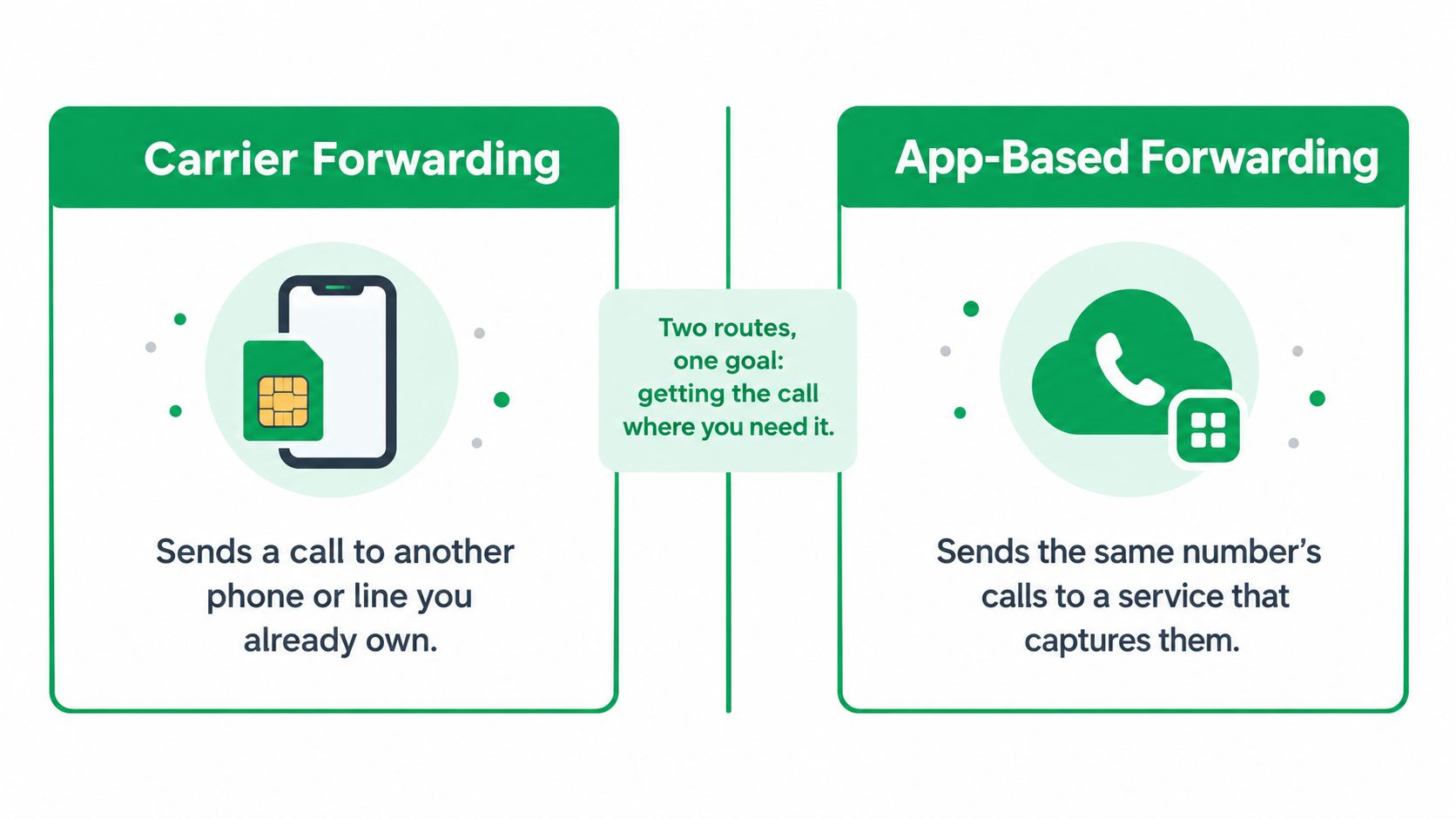
Forwarding to a phone versus app-based capture
| Criterion | Forward to another phone or line | App-based capture (VoxNote) |
|---|---|---|
| Who answers | A person on the destination line | You, as usual; the call is recorded in the background |
| Incoming records | Only if the destination records the call | Transcript, summary and email after each call |
| Outgoing calls | Placed from your usual app; not captured by the forwarding rule | Dialled from our app for capture, with your own number displayed |
| Setup | Dial codes or carrier settings | Account, iPhone app and forwarding enabled; about 5 minutes |
| Cost | Carrier per-minute or add-on fees | Carrier forwarding fees may still apply |
For our inbound workflow on a personal number, call forwarding is required. Once connected, incoming calls are captured automatically, and you answer as you normally would without a noticeable difference. You can disable forwarding whenever you need to.
The outgoing-call distinction deserves particular attention. An incoming forwarding rule doesn't intercept calls you place from your usual Phone app; for capture, dial from our app instead, and your client still sees your own number.
Choose by the job at the destination
Say a mortgage broker wants an assistant to arrange appointments while the broker is occupied. Forwarding to the assistant's phone addresses that need. Adding transcription doesn't replace the assistant's authority to manage the calendar or decide which calls need escalation.
A different broker may answer personally but need a dependable account of requested documents and agreed next steps. In that situation, capture and review matter more than transferring responsibility to another person.
For a broader system decision, our comparison of Aircall alternatives provides context for evaluating a mobile workflow against a separate business-phone arrangement.
The demonstration below shows how the capture workflow fits around a call.
Don't choose an app destination expecting it to remove carrier charges. Budget for the forwarding route separately, and make sure your team understands which dialler to use for outgoing conversations that need documentation.
Choosing a Forwarding Option for Your Situation
Choose unconditional forwarding when every incoming call needs the same downstream handling and you accept the associated forwarding cost. Choose conditional forwarding when you want the original line to have the first chance to answer.
The ITU-T call-offering service definitions distinguish unconditional, busy and no-reply forwarding by their trigger conditions. For a working professional, the important consequence is what each condition leaves outside the forwarded workflow.

Match the default to your working day
- A broker handling overlapping conversations: Start with busy forwarding to an assistant or answering destination. Accept that being in a meeting doesn't itself make the line busy; unanswered meeting-time calls need a different trigger.
- An advisor travelling with unreliable availability: Consider unconditional forwarding to a staffed destination. The trade-off is diverting calls you might otherwise have answered and potentially paying for more forwarded minutes.
- A professional who misses calls between tasks: Use no-reply forwarding as a backup. Accept a waiting period before diversion, and verify that voicemail doesn't take the call first.
- Someone receiving calls abroad: Confirm roaming treatment and destination-country eligibility before choosing a mode. A familiar domestic setup isn't proof that the same arrangement is economical overseas.
- A team seeking consistent incoming-call documentation: Route incoming calls unconditionally through the capture workflow. Conditional forwarding provides selective coverage, not a record of conversations answered directly on the original line.
Don't confuse selective routing with complete coverage
Conditional forwarding can be a sensible way to avoid diverting calls unnecessarily. But it also creates a documentation boundary: a directly answered call never reaches the forwarded destination.
That's acceptable when the purpose is overflow coverage. It's a poor fit when colleagues assume that every client conversation will appear in a shared call record.
The best option is the one that fails least for the calls you can't lose, not the one that forwards the most.
No-reply timing deserves a deliberate choice. A long wait gives you more opportunity to answer but makes the caller wait longer for backup; a short wait can divert calls just as you reach the handset.
I would choose the simplest rule that addresses the actual failure, then add another condition only when testing reveals a remaining gap. Avoid enabling every available option merely because the menu offers it.
Testing, Protecting and Starting Forwarding
Forwarding routes a call; it doesn't authenticate the caller. A familiar caller-ID display on a forwarded call is not sufficient evidence to release client information or act on a payment instruction.
The FCC's January 2025 mortgage-relief scam warning described a campaign targeting homeowners in all 50 U.S. states and causing hundreds of thousands of dollars in losses. For professionals handling mortgage, insurance or investment matters, verification needs to remain separate from call delivery.
Use the checklist as an operational sign-off, not just a settings check.
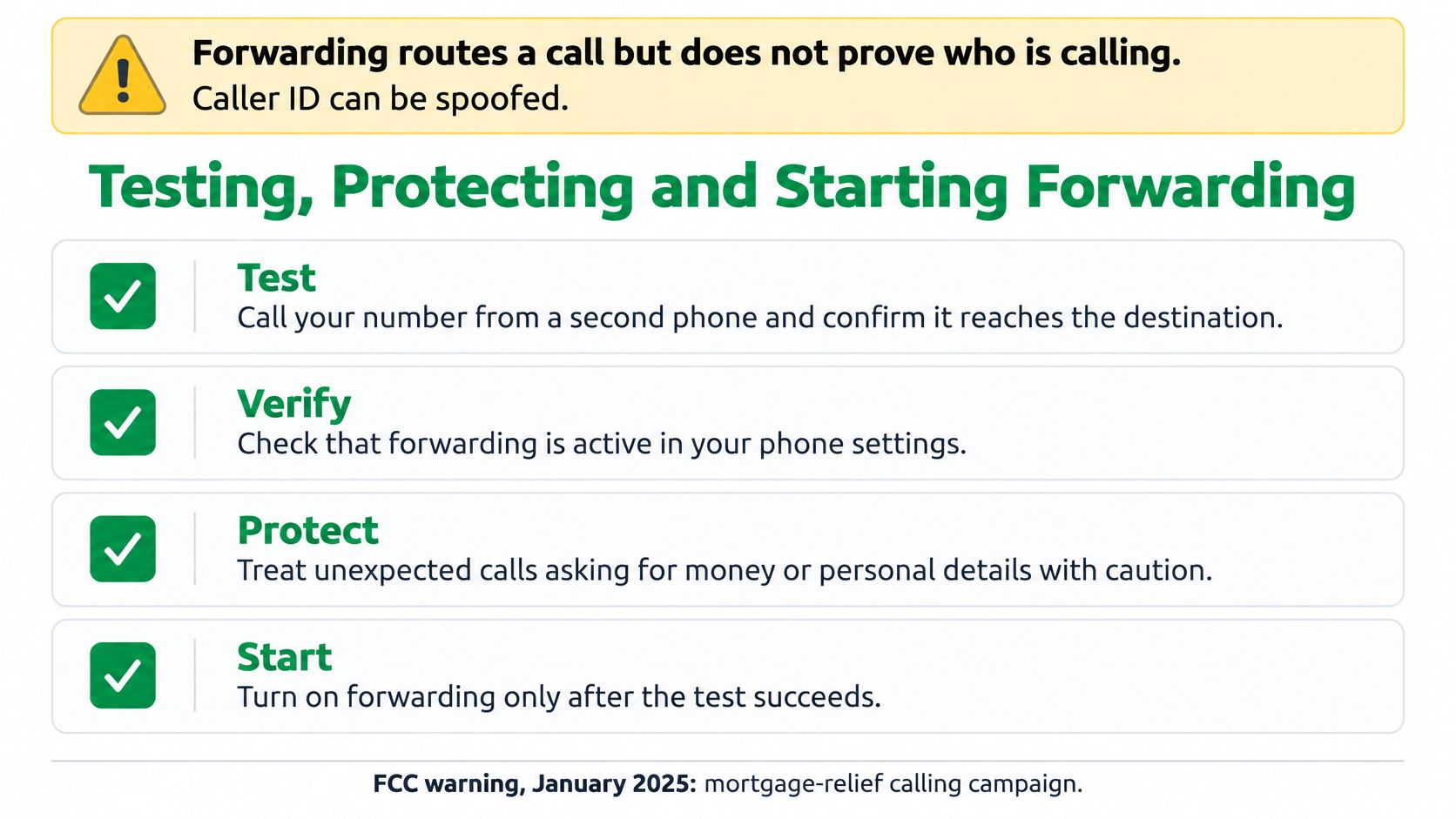
Test each condition independently
- Answered call: Call from an external number and answer normally to establish the baseline behaviour.
- Busy line: Keep the business line occupied, then place another incoming call.
- Declined call: Reject an incoming call and note where the carrier sends it.
- Unanswered call: Let the phone ring until the network takes action.
- Unreachable handset: Make the handset unavailable and check the resulting destination.
- Voicemail interaction: Confirm which mailbox answers when neither you nor the forwarded destination picks up.
- Configuration record: Write down the destination and cancellation method for each active rule.
Test busy behaviour with your actual call-waiting configuration. Don't assume declining a call, ignoring it and losing signal all invoke the same forwarding rule.
Record the outcome in plain language, such as “assistant answers overlapping calls” or “destination voicemail answers after no reply.” If the outcome is wrong, fix that condition before combining it with others.
Protect the account and the conversation
- Restrict changes: Protect the carrier account with a PIN and limit who can alter routing.
- Notify colleagues: Tell the receiving person when forwarding starts, what they may discuss and when coverage ends.
- Verify sensitive requests: Call back using a trusted number already in your records before discussing money, credentials or confidential client details.
- Use a suitable destination: Avoid shared handsets or unattended lines for sensitive conversations.
- Investigate service loss: Review carrier activity promptly if your mobile service disappears unexpectedly; account compromise or an unauthorised number transfer needs urgent attention.
Security boundary: Successful delivery proves that the route works. It doesn't prove that the person speaking has authority to give instructions.
Start with a documented decision
Name the call you can't afford to lose. Confirm the plan allowance, forwarding rate and destination eligibility, then configure the matching rule and run the external-call tests.
If the workflow needs a written record, our onboarding involves creating an account, installing the iPhone app and enabling forwarding through the app instructions, taking about 5 minutes. You keep your established number, and the first call summary arrives by email after the call.
Recording and transcription require a separate compliance decision. You're responsible for the rules that apply to your location and profession; our guide to recording a call on iPhone provides additional setup context, not a substitute for those obligations.
We recommend explaining at the start that the call is recorded and transcribed, stating the purpose, and asking whether the other person wishes to proceed. For example: “This call is recorded and transcribed so I can document your instructions and next steps. Are you comfortable proceeding?”
Schedule a one-month review before you finish setup. Compare the carrier bill with the missed-call log, check whether the intended calls reached their destination, and change any conditional rule that produced the wrong outcome.
VoxNote uses call forwarding to connect incoming calls on your existing number with transcripts, summaries and follow-up drafts, while outgoing calls are captured when dialled through the app. Visit VoxNote to set up the workflow, then test your routing and confirm your carrier's forwarding allowance before relying on it for client calls.