
You're driving between appointments when a client calls your mobile, agrees to a rate, names a beneficiary, and asks for a document by Friday. You listen, you drive, and you don't write any of it down. An hour later, you're trying to rebuild the details from memory before you send the follow-up.
That's the problem behind phone call recording. You don't need a hidden audio file you'll never replay. You need a reviewable written record you can check, correct, and file. Whether that record is safe to rely on depends on two things most tool reviews skip: the thin sound a phone line carries and the consent you get before capture starts.
Table of Contents
Phone Call Recording Methods Compared
People who search for phone call recording usually want one thing: a reliable account of a live conversation. The gadget matters less than whether the method gives you both voices, clearly enough to use later. Judge each option below by that test.
| Method | What it captures | Best for | Main limit |
|---|---|---|---|
| Built-in handset recorder | One or both sides, if the carrier allows it | A quick personal memo | Often blocked on ordinary cellular calls |
| Merge-call recording app | Both voices through a conference bridge | Two-party capture when the handset cannot record | Extra tone, lower quality, and a required notice |
| Speakerphone and a second device | Room audio of both people | A fallback with no carrier support | Noise, distance, and smeared names or numbers |
| Carrier voicemail | Only the message left when unanswered | Missed-call messages | Not the live two-way conversation |
| Call-forwarding transcription | Both legs on the existing number, then a written record | Client notes and follow-up | Setup required, and the user must still disclose |
What Each Row Means in Practice
A built-in handset recorder is the picture many people start with. You tap a button and the phone saves the call. The catch is that many carriers block this on ordinary cellular calls, so the recorder may save only your side or fail while you assume it worked. A silent failure is worse than no tool, because you stop taking notes.
A merge-call app works around that block by pulling both legs into a short conference. It can catch both voices, which is the point. But the bridge often adds a tone and drops the sound quality, and you still owe the other person a spoken notice. The extra joining step mid-call also breaks your attention at the worst moment.
Speakerphone plus a second device needs no carrier feature at all. You put the call on speaker and record with a tablet or spare phone. It records the room, though, not just the call. Traffic, a keyboard, and the distance from the speaker all smear the details you care about most, names, rates, and addresses.
The Two Options People Confuse
Voicemail isn't call recording. It keeps only a message someone leaves after a missed call. It tells you nothing about the live two-way talk where decisions get made.
Call forwarding into a transcription service takes a different route. Clients keep dialing the number they already know, both legs get captured, and you get a written record without pressing anything mid-call. If you're weighing services, compare transcript accuracy and export options before you commit, because a transcript you can't move into your client file is only half a solution.
Decision rule: Keep audio only if the sound file itself matters. Choose a checked transcript when the goal is follow-up.
Don't switch any method on yet. Every row in that table needs the consent habit covered below, and turning capture on first is how people create a record they can't legally use.
Why Phone Audio Misses Important Words
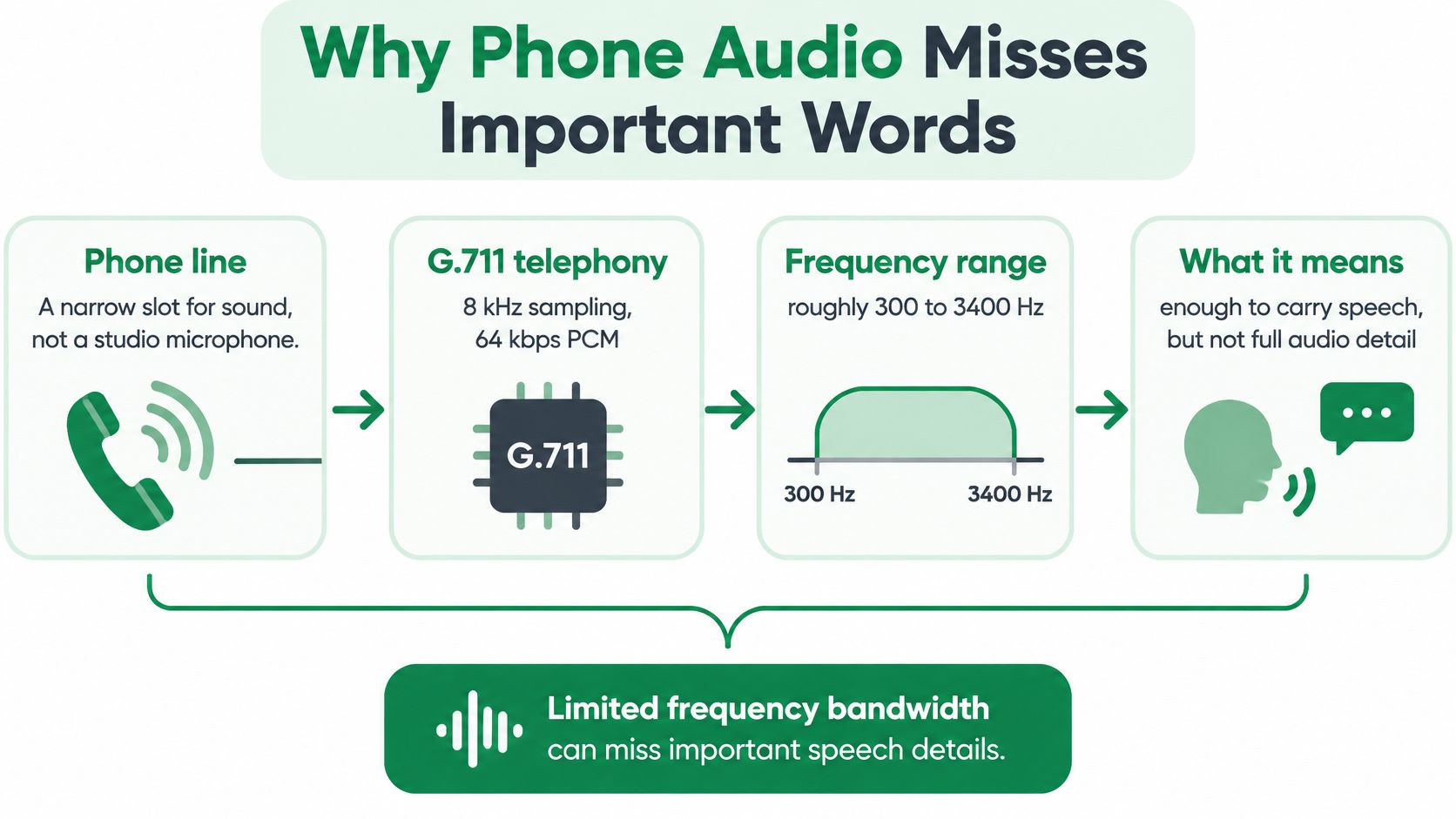
Think of a phone line as a letterbox slot for sound. A studio microphone takes in the whole voice. A phone line takes in a narrow strip of it, enough for you to follow a sentence, not enough to preserve every clue that separates similar words. The transcript only ever sees what fits through that slot.
The Numbers Behind the Slot
The MDN guide to audio codecs describes conventional G.711 narrowband telephony sampling audio at 8 kHz, using 64 kbps PCM, and representing approximately 300 to 3400 Hz. That band preserves intelligibility, but it removes much of the acoustic information above the telephone voice band, including higher-frequency consonant cues. Those cues are what help separate a soft f from an s, or one surname from a similar one.
ITU-T G.711.1 is wider. At 16 kHz sampling it supports approximately 50 to 7000 Hz at 80 or 96 kbps, while its 8 kHz mode supports up to roughly 4000 Hz. More bandwidth gives speech recognition more to work with, but only if every link in the chain keeps it.
| Codec or mode | Sampling | Bitrate | Usable band |
|---|---|---|---|
| G.711 narrowband | 8 kHz | 64 kbps PCM | about 300–3400 Hz |
| G.711.1 wideband | 16 kHz | 80 or 96 kbps | about 50–7000 Hz |
| G.711.1 8 kHz mode | 8 kHz | Codec-selected rate | up to about 4000 Hz |
Where the Detail Gets Lost
Follow the chain in order. Narrowband routing reduces phonetic detail first. That makes overlapping speech, names, numbers, and weak consonants harder for automatic speech recognition. Wideband-capable routing helps, but only when the carrier, forwarding path, handset, and recording pipeline all preserve that bandwidth. One narrow link narrows the whole call.
A second squeeze makes it worse. Transcoding through a conference bridge or picking the call up with a room microphone throws away still more detail. So keep the original channel audio, record both participants as separately identifiable channels when the system can, and avoid unnecessary transcoding. If you're new to how audio becomes text, this primer on how speech to text conversion works fills in the basics.
How to Test What Matters
Judge quality with word error rate, which NIST defines as substitutions plus deletions plus insertions divided by the number of spoken words. Then test on your own kind of calls, with names, monetary amounts, policy terms, and addresses, not clean news audio.
A low overall error rate can still hide one expensive wrong figure.
A transcript can score well on ordinary sentences and still get the one number wrong that you'd quote to a client. That's why the test set matters more than the headline score.
Consent Rules and the Words to Say
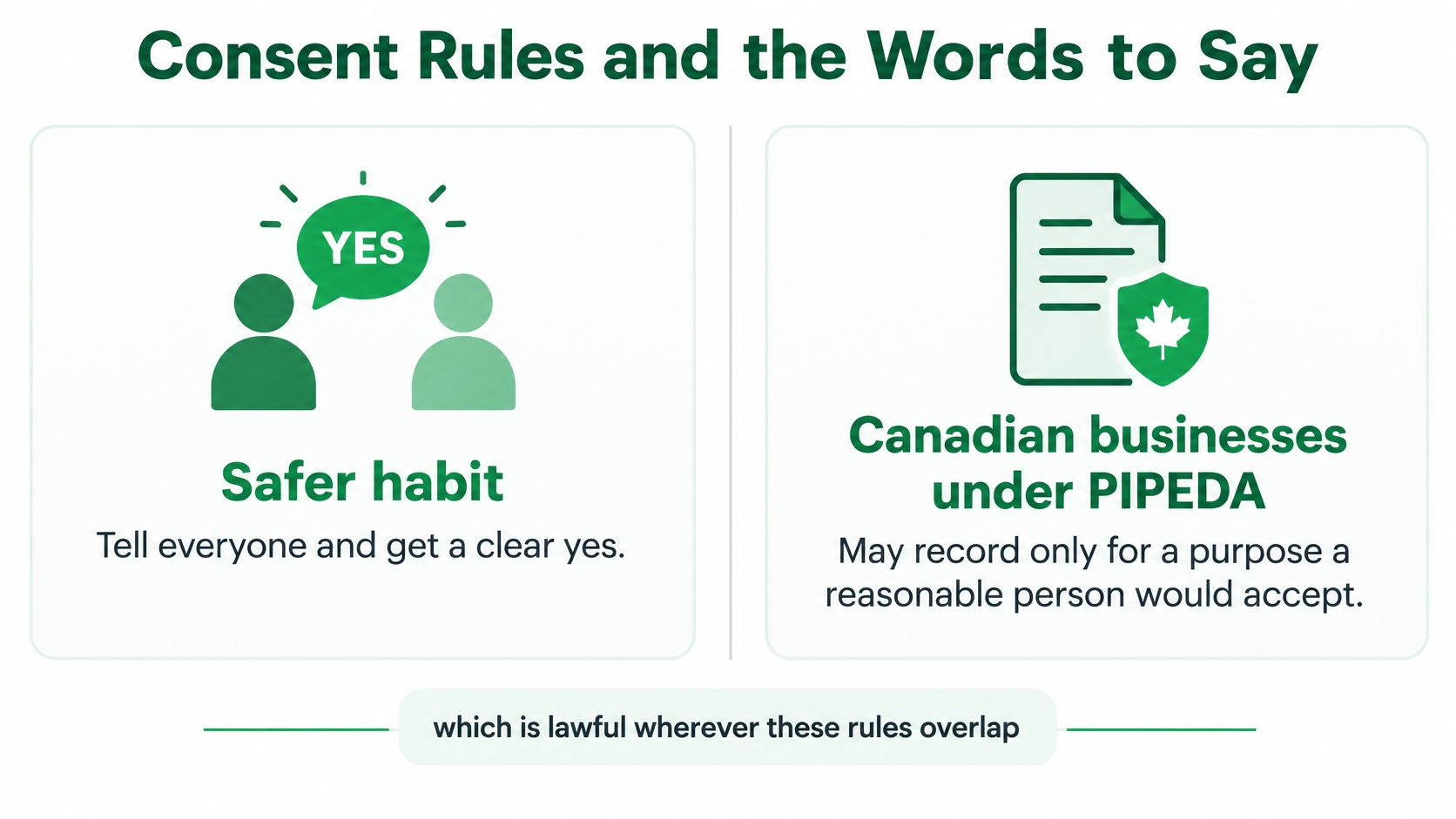
Start with the safer habit. Tell everyone and get a clear yes. That approach is lawful wherever these rules overlap, and it removes the guessing that gets advisors in trouble. Consent isn't a footnote to the method. It's the first step of it.
The Canadian Baseline
In Canada, the Office of the Privacy Commissioner guidance on recording customer calls states that businesses subject to PIPEDA may record customer calls only for purposes a reasonable person would consider appropriate. The organization must notify the customer that the call is being recorded, explain the purpose, and obtain meaningful consent. Consent may be implied when a customer continues the call after receiving clear notice of the recording and its purpose.
That guidance applies whether the customer or the organization initiates the call. So it covers your outgoing check-in calls and the inbound calls clients place to you. In practice, announce recording clearly at the beginning, name a legitimate purpose such as accurate documentation or follow-up, and give the person a real chance to object.
The US Baseline
Rules in the United States differ by jurisdiction. Some laws permit recording when one participant consents, while other jurisdictions require all parties to consent, and all-party consent is universally permissible when obtained, as the FCC directive on recording telephone conversations reflects in its consent framing. Don't guess which rule applies from an area code, because people move and keep old numbers. Have a local lawyer confirm the exact state before you deploy anything.
For professionals serving both Canada and the United States, the safest default is an all-participant notification and affirmative consent workflow. It costs you fifteen seconds and it works on both sides of the border.
| Situation | Safer practice before capture | If the other person objects |
|---|---|---|
| Canadian business call under PIPEDA | Notify that recording will happen, state the purpose, and accept implied consent only after that clear notice | Stop recording and offer to continue without it |
| US all-party jurisdiction | Get agreement from every participant before capture | Do not record |
| US one-party jurisdiction | One participant's consent can be enough, but an all-party notice is the safer client-work default | Honor the objection anyway |
| Cross-border or unknown location | Use all-participant notice and do not guess from the phone number | No silent capture |
| Team or internal call | Follow employer policy and tell everyone on the line | Pause or exclude the call |
The Five Step Spoken Notice
We recommend verbal disclosure at the start of each call, stating that the call is recorded and transcribed, its purpose, and asking whether the other party wishes to proceed. Here's the sequence that makes that real.
- State one purpose: Say it's for your notes and a follow-up email, with no hidden second use.
- Announce at the start: Say the call will be recorded and transcribed, and ask whether they want to continue.
- Wait for a yes: Accept a clear agreement, or them staying on the line after a notice that says staying means consent.
- Honor a refusal at once: Stop capture and continue without a record, or reschedule.
- Log what happened: Note the script version, time, call direction, and who agreed, then exclude anyone who has refused.
Consent duties show up outside client work too. Anyone documenting conversations with your co-parent faces the same basic question of who agreed to capture and for what purpose. The habit travels even when the setting changes.
Why the Human Notice Is the Control
An automatic recorder that starts at the first ring doesn't create permission. Our clients don't need to install an app or link, and they receive no notice that the call is being recorded from the system itself. That means the spoken disclosure is the only notice they'll ever get.
Before recording a call with us, you're responsible for informing all participants and obtaining any legally required consent.
Build the technical companions around that duty. Use a configurable disclosure before recording begins, keep a no-recording fallback instead of capturing audio, and log the disclosure version, timestamp, and jurisdictional policy. Then protect what you've captured. Encrypt recordings and transcripts in transit and at rest, separate access to raw audio from access to summaries, set retention and deletion schedules, and keep an audit trail for exports to your CRM. An accurate transcript handled loosely becomes a privacy incident, not an asset.
Set Up Recording on Your Own Phone Line
Start with the phone your clients already dial. Check what it can capture before you turn anything on, because each device type fails in a different way.
Check Your Device First
- iPhone: Most owners can't rely on a built-in recorder for ordinary cellular calls. Check current iOS and carrier rules, and use a merge-call app or a forwarding service when you need a live two-way record.
- Android: Some phones include a native call recorder, but availability depends on model, software version, and country. Open the phone settings and test it before you rely on it.
- Landline: A recorder, or a speakerphone with a second device, captures the room. Place the microphone close to both speakers and expect quieter voices to fade.
- VoIP or softphone: Review the app's recording settings. Many apps record only when you enable it, and they may not announce recording to participants.
- Forwarding to a transcription service: Set call forwarding on your existing number, confirm both incoming and outgoing legs are captured, and place one test call to a colleague. Reviewing your call forwarding options first helps you pick the setup that matches your carrier.
The Test Call That Must Pass
Before any live client call, run one low-stakes test end to end. Enable the disclosure, select the contacts you want excluded, make the call, and confirm the transcript appears. Say a name, a dollar amount, and a date out loud so you can check the words that matter most.
Then record the device, carrier, and forwarding path in the client file. If quality drops later, that note tells you where to look. A setup you haven't tested is just a hope, and hopes don't produce client notes.
Verify Facts Before Anything Is Filed
A transcript can get a rate wrong while making the sentence look perfectly clear. That is why the audio, transcript, summary, and client-file note each need a separate check before you rely on them.
| Record | Careful handling | Before you trust it |
|---|---|---|
| Raw call audio | Delete after the transcript is checked, unless law requires longer | Keep it only when tone or exact wording may be disputed |
| Full transcript | Keep for the stated purpose with a set expiry | Recheck names, amounts, dates, and negations |
| Summary | Keep with the transcript, not as a substitute for it | Confirm it does not invent an agreement |
| CRM or client-file note | Store only confirmed facts | Never paste an unchecked figure or commitment |
Raw audio contains a person's voice and details you may not need in a file. With VoxNote, phone call recordings are securely stored and then completely deleted and destroyed after 30 days. Ordinary call audio is also deleted from the temporary systems of the telephony and transcription providers after the transcript is created. Deletion normally happens shortly after processing, though retries, outages, security incidents, or legal obligations can delay it.
Written records have a different retention period. VoxNote keeps call metadata, transcripts, summaries, and related generated tasks for up to 36 months from the call, unless deleted earlier or a longer period is required by law. Check the provider's current policy before deciding what to retain.
Three Mistakes That Sound Fine
A mortgage broker discusses a rate of 4.89, but the draft transcript says 4.98. The sentence reads smoothly, yet that wrong figure could be copied into a follow-up email. Fluency is not proof of accuracy.
A life insurance advisor hears a beneficiary's surname, and the software substitutes a more familiar spelling. A field salesperson hears “not before Friday,” but the summary drops “not.” In the first case, a name may point to the wrong person. In the second, a delay can become an apparent promise.
Accents, two languages in one call, overlapping speech, names, numbers, negations, and poor mobile audio can all lead to plausible but incorrect text. In financial and insurance conversations, a small error in a rate, coverage limit, beneficiary, investment instruction, or deadline can have serious consequences.
The Verify Before Filing Routine
Treat a transcript as a draft witness statement. It helps you review the call, but a person still needs to check what matters before it enters the file.
- Mark uncertain passages: Flag unclear wording rather than accepting a smooth guess.
- Check load-bearing facts: Compare every rate, amount, date, name, negation, and commitment with what you heard.
- Separate words from interpretation: Keep the client's stated words distinct from what a summary infers.
- Confirm material decisions: Ask the client to confirm before sending an email or changing a CRM field.
A written record is useful because it can be reviewed. The audio may help resolve a question about tone or exact wording, but consent and the accuracy of the transcript determine whether the record is safe to rely on.
Before using any call record, check who can access it, how deletion requests work, what happens after a breach, and whether summaries are used for model training. Clients may be wary of AI handling their information. A privacy promise alone may not settle that concern. Showing the figures you have confirmed, and asking the client to confirm them too, makes the process easier to understand and review.
Pick a Record You Can Stand Behind
The decision comes down to two lines. Keep a short, lawful audio file only when tone or exact wording may be disputed. Use the transcript and summary as the everyday record, checked by a person before anything is sent or filed.
For a mortgage broker, insurance advisor, planner, or field salesperson, the sequence is fixed. Write the fifteen-second disclosure first. Decide which contacts are excluded. Only then connect a tool to the mobile number clients already know. Reversing that order is how capture starts before permission does.
We fit that pattern for Canada and the United States. Once call forwarding is connected, we transcribe incoming and outgoing calls on your existing number, and you dial outgoing calls from the app so the client still sees that number. You press nothing mid-call, and your notes stay together the way good logging of phone calls should keep them. The app doesn't replace your spoken notice, and figures still need your check.
Run one practical test before you trust any of it. Make a low-stakes call, compare the transcript with what you remember, and correct the names and numbers. Only then rely on it for a client file.
Connect your existing mobile number through call forwarding and VoxNote will transcribe your incoming and outgoing calls, then send you a summary and follow-up draft seconds after you hang up, with nothing to press during the call. Say your disclosure, check the figures, and file a record you can stand behind.