
A broker pulls into a parking lot, takes a call about a mortgage renewal, hears a rate, a request for a notice of assessment, and a deadline on the 14th, then drives to a showing. By the time the car is in gear, the details are already going soft.
That pattern isn't a discipline problem. A peer-reviewed study of office workers recorded an average of 25.52 interruptions during a workday, with phone calls accounting for 6.63 of them (the study in Work: A Journal of Prevention, Assessment & Rehabilitation). Calls arrive in the middle of other work, and the memory of them gets overwritten by the next task.
A call transcription app exists to close that gap. The call gets written down while you're still talking, and a record is waiting when you're ready for it. Three things decide whether it helps you or creates new work: how the capture chain runs, what accuracy means on names and dollar figures, and where recording consent changes what you're allowed to do.
Table of Contents
- How a Call Transcription App Captures a Conversation
- Features to Assess Before You Choose an App
- Accuracy Limits and Speaker Checks Before Sending
- Recording Consent Across Provinces and States
- Where Transcripts Save the Most Time
- Pick an App and Test It on One Week of Calls
How a Call Transcription App Captures a Conversation
Say a financial advisor takes a client call between two meetings. The client mentions a contribution figure, asks for a statement, and names a deadline. Nobody presses record. No notetaker joins the line. By the time the advisor is back on the road, a full transcript and a summary sit in the app and in the inbox.
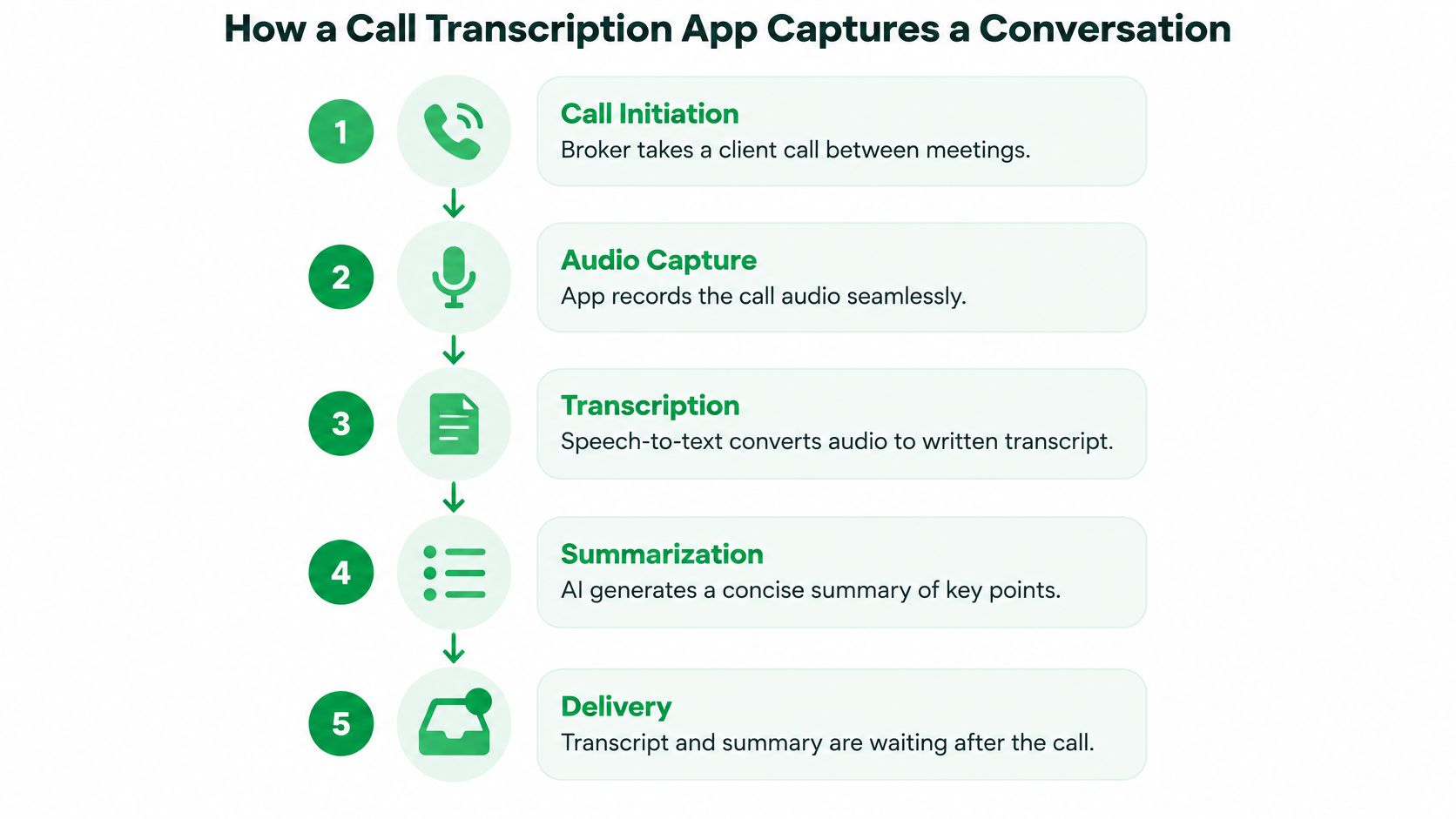
The chain runs in five stages, and each one answers a question a buyer should ask.
- The call arrives on your own number. Clients dial the number they already have. Once call forwarding points to the service, incoming calls reach it without you doing anything mid-conversation.
- Recording starts when the call connects. Capture begins at the moment the call begins, which is why nothing has to be pressed and no assistant appears in the participant list. The client answers like any other phone call, with no app, link or installation on their side.
- The audio becomes text. Speech recognition turns the recording into a written transcript, and automatic language detection keeps a call that drifts between English and French readable on both sides.
- A summary is written for the call type. Figures, decisions and next steps go into a structure that fits the conversation rather than a generic paragraph, and land in the app and the inbox seconds after the call ends.
- The audio is cleared. Ordinary call audio is deleted once the transcript is saved, normally shortly after processing. A retry, an outage, a security incident or a legal obligation can delay that deletion, so treat audio retention as something to confirm rather than assume.
The infographic below traces the same five steps end to end.
The closest everyday comparison is a stenographer who sits in on every call and hands you a typed page before the phone is back on the desk. You don't brief them, you don't wait for them, and you don't have to reconstruct what you said an hour later.
Two details decide whether this holds up in practice. Outgoing calls are dialled from the app rather than the phone's own dialler, so the client still sees your number and the change affects your routine, not theirs. And the transcript should be reachable from a computer, not only from the phone you happened to be holding, so it can be found and copied into a client file later.
One thing the chain does not do is finish the job. What it produces is a draft, and names, rates and dollar figures are exactly where transcription errors do their damage. The transcript earns a read-through before anything in it reaches a client file, and whether you may record at all depends on consent rules that vary from place to place.
Three things are worth tracing on your own calls this week: where the transcript is stored, what the summary contains, and which steps you control, including forwarding, excluded contacts and stopping a transcription mid-call.
Features to Assess Before You Choose an App
A product page will tell you that an app transcribes calls. It won't tell you whether the app hears an interest rate correctly, whether it labels the person who promised a callback, or whether the plan you're looking at includes the CRM connection at all.
Use the table below as a scoring sheet rather than a reading list. Run two or three apps side by side on the same ten rows during a trial, mark each row pass or fail against your own recorded calls, and ignore any row that doesn't touch your work.
| Feature | What to Check | Why It Matters | Red Flag |
|---|---|---|---|
| Capture method | Works on your existing number with call forwarding | Clients keep calling the number they already know | Client must join a link or install an app |
| Transcript accuracy | Tested on your own recorded calls, with names and figures checked | A headline accuracy claim can hide errors in numbers | Only a single overall accuracy percentage |
| Speaker labels | Each turn tagged with a speaker and editable | Shows who made each promise | Unlabelled text blocks |
| Summary format | Organized by call type with figures, decisions and next steps | Turns a call into an action list | Generic paragraph summary |
| Follow-up drafts | Editable drafts based on agreed actions | Cuts time spent rewriting messages | Drafts sent without review |
| Search and export | Web access to past calls that can be copied into client files | Keeps records findable | Transcripts available only on the phone |
| Integrations | Named CRM connection and the plan that includes it | Avoids retyping summaries | Vague claim of working with everything |
| Language support | Automatic language detection and accent testing | Serves multilingual clients | English-only transcription |
| Security and retention | Encryption, deletion of raw audio, and a clear sharing policy | Transcripts hold financial and personal data | No stated policy on storage or access |
| Consent prompts | Disclosure script or prompt before recording | Legal duties on recording vary by location | No support for disclosure at all |
The Rows Buyers Underweight
Speaker labels and summary shape carry more weight than the box suggests. Labels decide whether the summary can say who promised what, and a summary built for the call type decides whether you get an action list or three vague sentences you have to rewrite anyway.
One row deserves more attention than it usually gets, and that's what happens to the archive after the call. VoxNote connects to Claude, ChatGPT and other popular AI tools so the assistant can read the transcripts of your calls. A folder of past conversations becomes something you can query directly: which clients mentioned a refinance before June, which calls ended without the document request being answered, which client asked you to hold off until the new year.
Access from a computer is the other quiet row. A summary you can only read on the phone in your hand is a summary you won't copy into a client file, so check that past calls are searchable and exportable from a browser.
Language, Storage and the Questions to Ask
Accent and language support needs testing rather than ticking. A 2025 study on speech recognition found Standard American English consistently outperformed other English varieties, while Turkish, Ukrainian and Italian were systematically underrecognised (the 2025 study on accent performance in speech recognition). If a share of your clients speak with an accent the vendor never tested, a polished demo tells you nothing.
Storage is where a five-minute question saves a long conversation with a compliance officer. Ordinary call audio should disappear once the transcript is saved, which is what we do: audio is deleted from the temporary systems of our telephony and transcription providers shortly after processing, though a retry, an outage or a legal obligation can delay it. We also don't have employees routinely listening to recordings or reading call content as part of transcription.
For a wider shortlist before you start scoring, compare leading transcription tools and bring the same ten rows to whatever you find there. Then narrow it down: pick the three rows that decide the purchase for your work, such as capture, numbers and security for a mortgage broker, or labels, summary shape and retention for an insurance advisor. Make those three pass-or-fail and let the rest inform the price.
Accuracy Limits and Speaker Checks Before Sending
The number on the marketing page is usually a single accuracy percentage. It tells you almost nothing about whether the transcript will get a policy number right or attach a promise to the wrong person.
What Word Error Rate Actually Measures
Word error rate (WER) is the share of words a transcript gets wrong, counted as substitutions, deletions and insertions against a human-checked reference transcript. It's the standard measure for telephone speech, and it moves a great deal with audio quality and the way people talk (an academic review of conversational telephone speech recognition).
| Benchmark or System | Speech Type | Reported Word Error Rate |
|---|---|---|
| Carefully tuned systems in an academic review | Conversational telephone speech, varying difficulty | About 20-40% |
| Later large-vocabulary systems | Easier benchmark calls such as Switchboard | Low single digits |
| Later large-vocabulary systems | Harder conversational subsets such as CallHome | Roughly double the easier benchmark |
The spread between those rows is the useful lesson. The topic of the conversation matters less than how the call sounds. People talking over each other, a switch between languages mid-sentence, industry jargon and a weak cellular signal all push a transcript toward the bad end of the range.
The number to distrust: a low overall error rate can hide mistakes in the small vocabulary that carries the money, which is names, dollar amounts, dates, policy numbers and action verbs.
That is why one fix beats chasing a headline percentage. Measure errors separately for names, amounts, dates, identifiers and action verbs. A transcript can score well across a whole call and still turn "not covered" into "covered".
Speaker Labels Are a Separate Problem
Getting the words right and knowing who said them are different engineering problems. Speaker separation, or diarization, answers a simple question: who spoke when. It works like seating people around a table using only their voices, and it gets harder the shorter each turn becomes. Labels tend to drift on rapid back-and-forth, on crosstalk where both people talk at once, and on weaker phone audio where the system has less signal to work with.
A transcript can contain every correct word and still assign the promise to the wrong participant. That reverses who agreed to a deadline, who requested documentation and who asked for a callback, and the mistake survives into the client file because the text reads perfectly well.
If the app marks a turn as low confidence, treat that line as unverified until you have heard the audio.
Seven Checks Before a Summary Reaches a Client File
Run these before any summary or follow-up draft leaves your desk.
- Confirm the speaker on every turn that contains a commitment. If the label says the client agreed to send a statement, check that the client is the one who said it.
- Compare every amount, rate and premium against the audio. A missing zero or a swapped digit is invisible in a clean-looking paragraph.
- Check each date and deadline, including the weekday. "Friday the 14th" is easy to transcribe and easy to transcribe wrongly.
- Confirm the spelling of names, addresses and account identifiers. Read them back from the transcript, not from memory.
- Check the negatives. A dropped "not" turns "we don't cover that" into "we cover that", which is the most expensive error on this list.
- Confirm each requested document appears in the action list. If the client named three documents and the summary lists two, find the third.
- Compare the next steps with what was said. Check the owner and the order of actions, not just the deadline.
The fixes that work are unglamorous: a custom vocabulary list for lender, fund and product names, post-processing for numbers and proper nouns, and a person reading every commitment before it goes out. If you still take notes by hand during calls, a focused note-taking method pairs well with a transcript, since the transcript holds the words while your notes hold the judgment.
Treat the output as a searchable working record, not an unquestioned legal record. That framing keeps the productivity gain without pretending the text is evidence.
Recording Consent Across Provinces and States
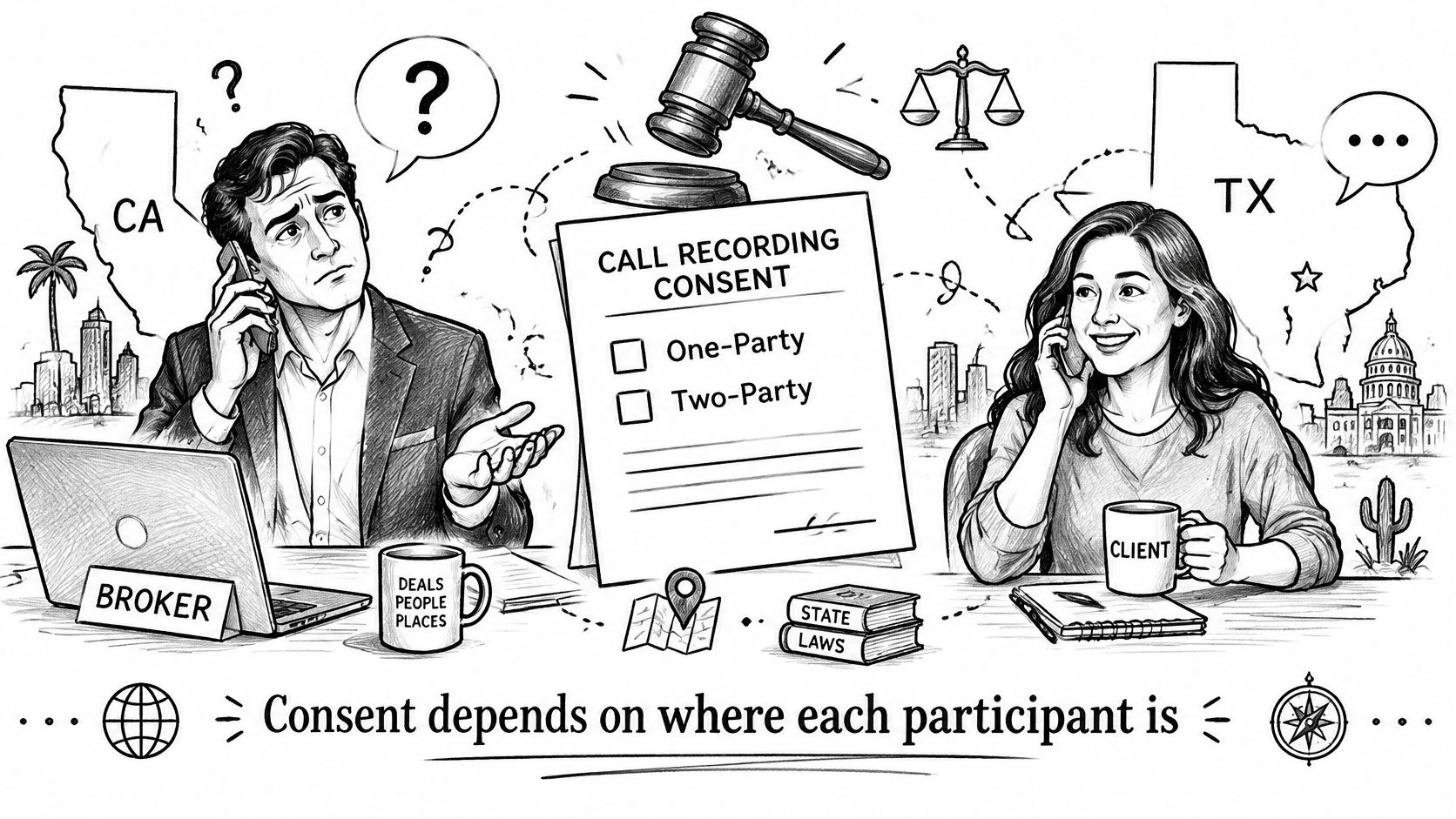
Most guides settle the consent question with two words, one-party or two-party. That shortcut doesn't survive a phone that rings in Toronto, Buffalo and Boca Raton in the same afternoon.
Which rule applies can depend on where each participant is, which state is involved, why the call is being recorded, and how the transcript will be stored or shared afterwards (RecordingLaw's guide to recording phone calls in Canada). Federal Canadian criminal law generally permits a participant to record with one-party consent, while U.S. requirements vary by state and several states require consent from all participants.
Making the recording lawful isn't the end of the obligation either. Canadian commercial organisations must also explain why personal information is collected and handle it appropriately, which is a privacy duty sitting alongside the criminal question rather than inside it. Encryption and deletion controls don't fix this: a securely stored transcript can still be collected without adequate notice.
A short disclosure at the start of the conversation is the part of the workflow that keeps everything else honest.
A Five-Step Routine for Every Client Call
- Note where each party is before you dial. The client's province or state is part of the call plan, not an afterthought.
- Follow the stricter rule when they differ. If any participant is somewhere that requires everyone to agree, get everyone's agreement.
- Disclose inside the first few sentences. Say the call is recorded and transcribed, say what the record is for, and ask whether the other party is happy to proceed.
- Give people a way to decline. If someone says no, stop transcription for that call or exclude the contact before the next one.
- Keep a record that disclosure was given. A dated note on the contact with the wording you used is enough.
Practical rule: when the parties sit in different jurisdictions, the stricter rule wins, and the disclosure happens before the substance of the call.
We recommend verbal disclosure at the start of each call, stating that the call is recorded and transcribed, its purpose, and asking whether the other party wishes to proceed. That's a working practice, not a legal shield. You stay responsible for the rules that apply to you and your profession, and those rules vary from place to place.
If you're weighing a dedicated recorder against a transcription service, how call recorder software works is worth reading first, because the consent step differs between the two setups. Write your disclosure line this week, keep it short enough to say while a client is still saying hello, and confirm it with your regulator or legal adviser before the next client call.
Where Transcripts Save the Most Time
A mortgage broker takes a call on the way to a showing. The client gives a rate, asks for two documents and sets a Friday deadline. Before the parking brake is released, the broker is answering a different client, and those three details are competing with a traffic light.
Interruptions rarely finish before the next one starts. A diary study of mobile professionals found interruptions just over four times an hour, with telephone calls prompting 14 percent of reported task switches, and 40 percent of disrupted tasks were not resumed immediately afterwards. The call ends. The note-taking happens four hours later, or not at all.
Calls also remain a channel clients choose for themselves. In 2024, 18 percent of Canadian investors who worked with a financial advisor preferred phone calls as their communication method, according to an Angus Reid survey of 1,001 investors commissioned by CapIntel and reported by Advisor.ca.
Who Feels It Most
Mortgage brokers and brokerage teams record rates, lender names and document lists, and a rate quoted with confidence in March is a rate someone will cite in June.
Life insurance advisors capture coverage amounts and beneficiary details, where a transposed digit becomes a conversation with a client nobody wants to have.
Investment advisors and financial planners log quarterly review decisions, and the value lies in showing what was agreed at the last review when memories differ.
Field and technical sales representatives agree specifications and delivery dates verbally, then need both in writing before the purchase order moves.
Entrepreneurs take client calls on a mobile phone and rarely sit at a desk, which is exactly where handwritten notes fail to happen.
The record is the point. A transcript nobody reads before the follow-up goes out is just a longer voicemail.
The gain is continuity. Each call's summary arrives in the inbox and the app seconds after the call ends, with the numbers, decisions and next steps already pulled out, so the human check before filing is a short read: confirm the client's name, the figure and the deadline, then copy the record into the client file. That review is where a transcript earns its place, because a rate or a surname still needs your eyes before anything reaches a client.
The client's side stays the same throughout. The app runs on your own number for incoming and outgoing calls, so people keep dialling the number they already know.
Once the record exists, it needs somewhere to live. If the next question is where transcripts and summaries should sit after each call, compare client management tools to see how professionals organise the file side of that workflow. And for the calls you never pick up, what an AI call assistant handles covers the screening and routing side of the same workflow.
Pick an App and Test It on One Week of Calls
Reading about an app and running one are different exercises. The assessment that matters happens across a single week of your own calls, with real clients, real figures and the interruptions that come with them.
- Shortlist two or three apps. Use the ten rows from the checklist and score them on one page. Score from a trial, never from marketing copy.
- Set up forwarding on your existing number. On iPhone, open Settings, search for Call forwarding, switch it on, tap Forward To, paste the number VoxNote gave you, then go back to save. On Android, open the Phone app, tap the three dots, choose Settings or Call settings, then Call forwarding, select Always forward, paste the number and tap Enable.
- Run one full week of real calls. Make sure the week includes a call with a second speaker in the room, a call with a strong accent or a language switch, and a call containing a dollar figure or a hard deadline.
- Check every transcript against the audio. Use the seven checks from the accuracy section rather than inventing a new list. Log each error by category: name, amount, date, identifier, negation, action.
- Compare cost on the same usage. VoxNote's Essential plan is listed at US$19.99 per month or US$199.99 per year and includes 500 minutes of notes a month. The Pro plan billed annually costs $349.99 per year, about $29.17 per month, and adds CRM delivery and team access. Set those against the other quotes using your own monthly call volume.
- Put the disclosure line in place before the first real client call. Testing on live clients without the disclosure step gets the order wrong.
Two checks finish the job. Read one complete summary as if a client were about to receive it, and ask whether you'd defend every figure in it. Then look at where the transcript goes next: if the path into your client file involves retyping, you've moved the work rather than removed it.
The decision at the end of the week is simple. Choose the app with the fewest errors in the categories that matter for your work, not the highest overall percentage on a page. Keep the summary review step whatever you choose, and keep the disclosure line after the trial ends.
VoxNote records and transcribes incoming and outgoing calls on the number your clients already dial, then sends a summary built around the figures, decisions and next steps from each conversation. You review the transcript, the summary and the follow-up draft before anything reaches a client file, and raw call audio is deleted once the transcript is saved. Run a week of your own calls and see whether the record holds up at VoxNote.