
Learn what phone call monitoring is, how businesses use it, and how it differs from transcription and recording in this clear, practical guide.
Phone call monitoring is the practice of observing, listening to, or analyzing conversations for quality, training, compliance, or record-keeping. It can mean listening live, reviewing captured audio later, or analyzing call data after the conversation, and each approach brings different privacy and accuracy responsibilities.
You're a mortgage broker on the phone with a client who's asking about a rate, a deadline, and which documents to send. One hand is on the calculator, another is reaching for a notepad, and the client has just added a detail you'll need to remember. Monitoring can help make a record of what happened, but it is not another name for recording or transcription. The distinction matters: before you choose a tool or switch on a feature, you need to know what it captures, who can see it, how long it remains available, and whether the client has agreed.
Phone call monitoring is a process for observing, listening to, or analyzing live or recorded calls for purposes such as quality, training, compliance, or record-keeping. Unlike personal note-taking, monitoring may involve a supervisor listening in, a recording saved for later, or software that analyzes audio and produces a transcript or summary. The term describes the broader practice, not one specific technology.
For a solo mortgage broker, that difference can be easy to miss. A call may be monitored live without being saved, recorded without being reviewed, or transcribed after the fact without anyone listening in as it happens. Each option creates a different kind of record and requires its own choices about notice, consent, access, and retention.
The stakes aren't only technical. Telephone recording technology dates to the 1890s, while major U.S. court decisions on wiretapping and privacy came in 1928 and 1967. Those milestones help explain why monitoring has long been connected to consent, purpose, privacy, and access, not just the ability to capture sound (history of telephone call recording laws).
A sensible starting point is to name what your workflow does. This guide distinguishes the layers of monitoring from recording and transcription, explains how cross-border consent and retention affect client calls, and shows why important transcript details need human review. The central idea is simple: monitoring is a process with rules and side effects, not a feature to switch on thoughtlessly.
Think of phone call monitoring like a security camera system. A camera can stream what's happening now, save footage for later, or make an archive searchable. A phone workflow can do the same kinds of jobs, but each layer gives you a different kind of visibility.
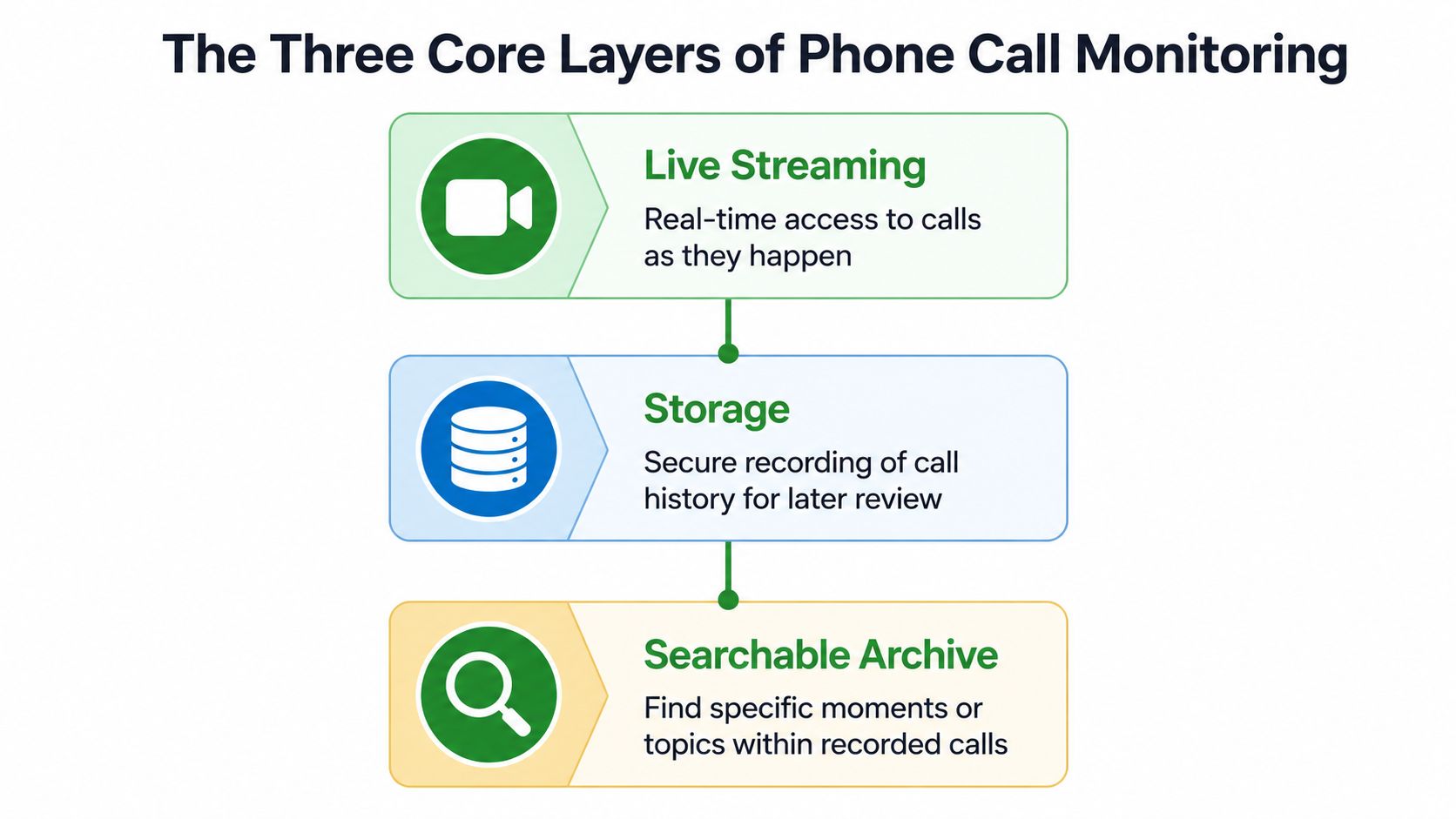
Live listening gives an authorized person access while a call is happening. A sales manager might listen to a junior representative's client call, then offer guidance privately through a feature sometimes called whisper coaching. If the manager joins the conversation directly, that's often called barging in. Live access doesn't automatically mean the call is recorded.
Post-call review means someone listens to audio that was captured and stored. A compliance officer, for example, might review a mortgage discussion later to check whether the professional explained a product clearly. This layer depends on the existence of an audio record and rules for who may access it and when it must be deleted.
Automated analysis uses software to process call audio or its transcript. A system might flag a missing disclosure, organize action items, or help a professional find a conversation by topic. Its output is not the same as a person's judgment: a flag can prompt a review, but it doesn't establish by itself what the client understood or what was agreed.
A solo professional may use one layer or combine them. A saved transcript used to find an earlier discussion is a searchable record; an invited colleague listening live is live monitoring. To plan a team process, these QA call monitoring steps offer a useful reference for setting expectations and reviewing calls.
Practical rule: Identify the layer first, then decide what notice, access, and retention controls it needs.
Monitoring can support ordinary client work when the business is clear about its purpose and keeps the process proportionate. The person being monitored may be an employee, but the other person on the call is a client who deserves to know what's happening.
Quality assurance is one common use. A team lead listens to selected calls to assess whether the professional explained options clearly, answered questions, and followed the business's service standards. For a client, the call should still feel like a normal conversation, not an examination. The team should explain the monitoring policy and avoid collecting more than it needs.
Training and coaching can turn a specific call into a learning conversation. A manager and a newer advisor might review how the advisor handled a client's question about an application. Instead of relying on memory, they can discuss the phrasing and identify what to do differently next time. Access to the call should remain limited to people with a coaching role.
Compliance review may focus on whether required information was communicated. In lending or insurance, an authorized reviewer might check whether a professional gave an explanation or disclosure at the right point in the conversation. Monitoring can help locate a call for review, but it doesn't replace professional judgment or establish that a client understood the terms.
Dispute resolution is more specific: a client and professional remember a promised follow-up differently, so an authorized person checks the available record. A recording may help clarify what was said, but it can also create a sensitive record that needs protection.
Operational analysis can help a business spot recurring call topics, such as confusion about a document request or a repeated question about next steps. A solo broker may not need a formal analytics program, but can still benefit from a consistent written record of client decisions and follow-ups. For a closer look at the documentation side of the workflow, see this guide to the best phone call notetaker for mortgage brokers.
The terms describe related activities, but they aren't interchangeable. Monitoring is the broader practice, recording captures audio, and transcription turns speech into text.
| Dimension | Phone call monitoring | Call recording | Call transcription |
|---|---|---|---|
| Purpose | Observe or evaluate calls for a defined business purpose | Preserve audio for later use | Create a written version of speech |
| Output | Live listening, review, flags, or other analysis | An audio file | A text transcript, sometimes with a summary |
| Who may access it | People authorized for supervision, review, or analysis | People authorized to handle stored audio | People authorized to handle transcripts and related notes |
| Consent implications | Depends on what monitoring includes and where participants are located | Audio capture may trigger notice and consent duties | Creating and retaining text can raise privacy obligations even if the workflow isn't described as recording |
| Typical storage | Depends on the monitoring setup | Stored audio, if the call is saved | Stored text, if transcripts are retained |
A client asking, “Are you recording this?” needs a clear answer about what your system does. Saying “we only transcribe” may not resolve the concern: a transcript is still a record of personal information, and capturing call audio to create it may have separate consent implications. Think about both the original audio and any derived material, such as a transcript, summary, email draft, or CRM entry.
The vocabulary can also help you evaluate a tool description. Live barge-in means an authorized supervisor joins an active call. Whisper coaching means a supervisor gives guidance to the professional without speaking to the client. Sentiment analysis is software attempting to categorize emotional signals in call data. Each feature has different effects on the call, the client's expectations, and the records your business creates.
Before using a feature, ask what it captures, when it runs, who can access the output, and how long that output remains available. “Monitoring enabled” isn't a complete description of the practice.
A Canadian advisor may work from one province, speak with a client in another country, and use a service that stores call information across systems. It's tempting to ask only whether recording is legal where the advisor sits. But the caller's location, the purpose of processing, and what happens to the transcript or summary can also matter.
Canada's Criminal Code generally permits interception with the express or implied consent of at least one participant. That doesn't remove an organization's separate privacy responsibilities. A business may also need to explain that recording is happening and why, obtain meaningful consent, protect the information, allow access where applicable, and keep it only as long as necessary. Quebec's Law 25 adds stricter privacy-management and breach-notification obligations. For U.S. calls, federal law provides a one-party-consent baseline, while state rules vary and some require all participants to consent. When participants are in different states, don't assume the professional's location alone settles the question (cross-border call-recording disclosure guidance).
Important distinction: Permission to capture a call doesn't automatically mean you should retain, summarize, email, or copy every detail into a client file indefinitely.
A practical disclosure should cover what the system does in plain language. For example: “I use a call documentation service to create a transcript and notes for follow-up. Is that okay with you?” Adapt your wording and process to the jurisdictions involved, and don't treat a sample sentence as legal advice.

Build the workflow around these checks:
A cross-border review should include downstream copies, not just the call platform. Transcripts sent by email or copied into a CRM need suitable access, audit, and deletion controls too. This data transfer compliance guide can help frame questions about information moving between jurisdictions.
An automatic transcript can look polished and still get a critical detail wrong. A useful way to understand transcription quality is word error rate, or WER: the number of substituted, deleted, and inserted words divided by the number of words in the reference transcript.
In NIST conversational-telephone evaluations, reported best WERs were approximately 19.3% for Switchboard and 31.4% for the more difficult CallHome task (telephone speech recognition accuracy). These results show why telephone audio deserves care: compression, packet loss, background noise, overlapping speech, and differences between handsets can make speech harder to recognize than clean, close-microphone audio.
But an overall score doesn't tell you which mistakes matter most. A misspelled filler word and a misheard interest rate are not equally consequential. For a mortgage broker, the useful question is whether the system reliably captures amounts, dates, names, account identifiers, policy details, negations, and commitments. A transcript could read smoothly while changing “I can't send it today” into a commitment to send it today.
For a practical approach to call notes and follow-up, see this guide to a daily phone call summary. Treat any generated text as a draft, not proof that every detail is correct.
An investment advisor starts with an ordinary call. Before using a call documentation tool, she decides what clients will be told, how consent is recorded, who can access the resulting information, and how long it will be retained.

She makes the call using her established number rather than asking the client to dial a separate work line. Once the client has received the appropriate notice and agreed to the process, the call can produce documentation for review afterward. If a compliance lead needs to listen live, that's a separate monitoring choice and should be disclosed and authorized under the advisor's procedures. Live access doesn't follow automatically from using a transcription tool.
After the call, a transcript and summary can help the advisor check the client's stated priorities and agreed next steps. She verifies the important details before copying them into the CRM or sending a follow-up draft. A phone call notetaker for field sales reps illustrates why professionals who work away from a desk may want call notes tied to their existing phone workflow. VoxNote is one documentation option: its iPhone app captures calls through the user's existing number and produces transcripts, summaries, and follow-up drafts for review.
The same call can now serve different purposes without confusing them. The transcript supports documentation; a permitted QA review supports coaching or compliance; and a retention rule governs how long each record stays available. If information moves from an app into email or a CRM, the advisor should apply appropriate access and deletion controls there too.
The workflow is easier to picture in motion. This product overview provides another look at the call-documentation experience:
The important distinction is that monitoring isn't a separate permission to reuse client information for any purpose. Each use of the call data still needs a defined reason, appropriate access, and a plan for what happens when the record is no longer needed.
Return to the mortgage broker juggling a client question, a calculator, and a notepad. With a clear workflow, the broker can focus on the conversation, explain any documentation process before it begins, and check the transcript or summary before using it to guide the next step. The client knows what's happening, and the broker knows which record is available for which purpose.
Phone call monitoring is a layered practice. Decide what you capture, why you capture it, who can see it, how long you keep it, and which details a person must verify.
Not necessarily. Some services work through an existing mobile number, while other setups may use a contact-center platform or separate phone equipment. Check how a tool connects to your calls and what it captures before relying on it.
Don't assume so. A transcript is a written record of a conversation, and the process may involve capturing audio to produce it. Explain what happens, determine the rules that apply to the caller and professional, and offer a suitable alternative if the client declines.
There isn't one retention period that fits every business or jurisdiction. Set a deletion schedule based on purpose and applicable requirements, and apply it to audio, transcripts, summaries, emails, and CRM copies. Keeping information “just in case” can create a longer-lived record than the work requires.
Before your next client call, confirm your notice, consent process, refusal alternative, access rules, deletion schedule, and human review steps. That checklist turns phone call monitoring from a vague feature into a deliberate professional practice.
VoxNote helps professionals document calls on their existing phone number with transcripts, summaries, and follow-up drafts they can review before sharing or acting on them. If that workflow fits your client practice, visit VoxNote to learn more.